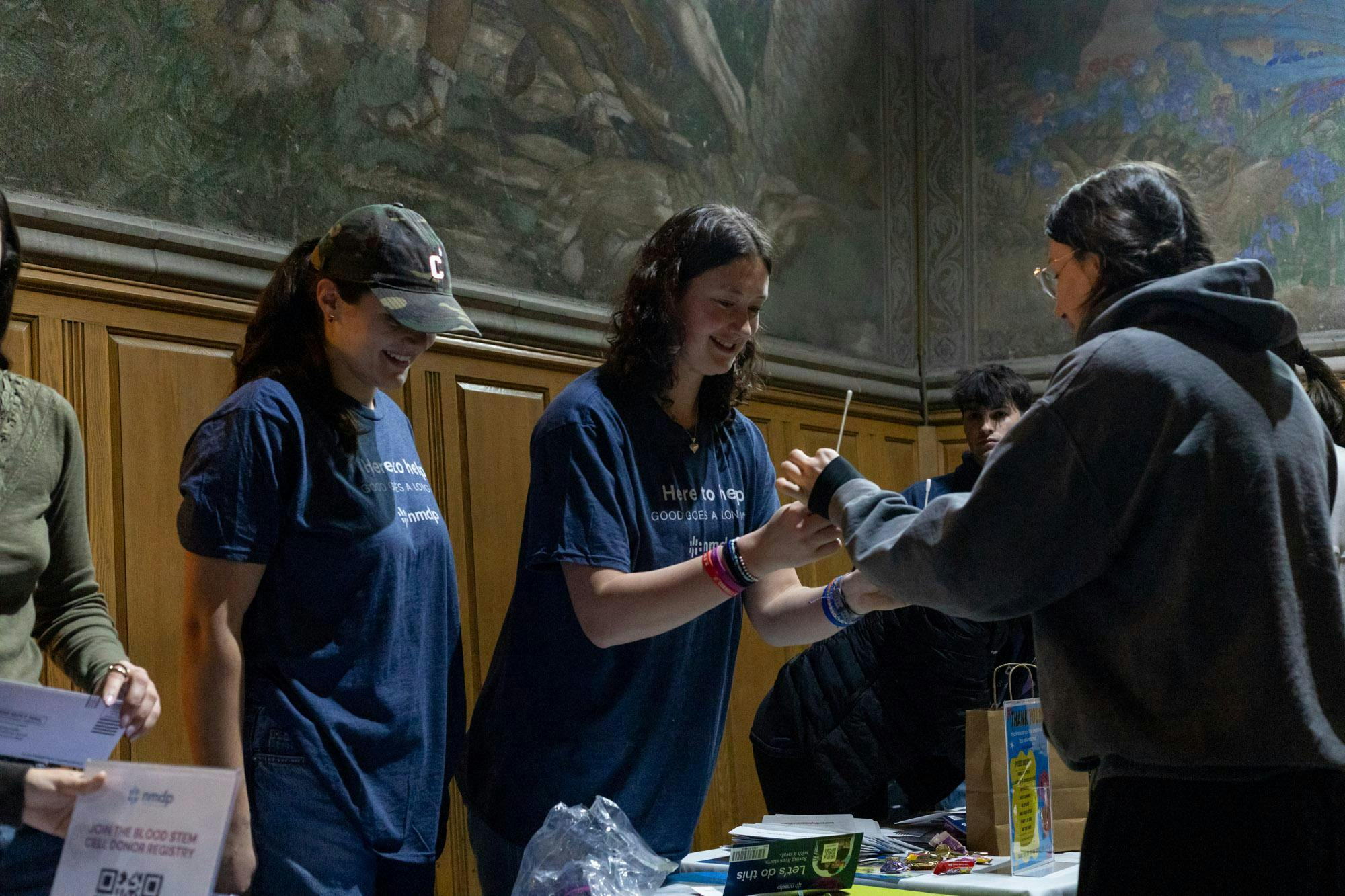
The National Donor Marrow Program hosted a stem cell donor registry event, Big Red, Big Impact, with the goal of adding 10,000 student DNA samples to the NMDP donor registry between March 13-20. Juan Uribe ’96 spearheaded the tabling event in an attempt to expand the stem cell registry to find a life-saving match for his son, Max Uribe.
In an interview with The Sun, Juan said that he reached out to President Kotlikoff to ask Cornell to host the sampling drive.
“He was immediately in problem-solving mode, thinking ‘how can we get this to happen,” Juan said. “He’s an angel.”
President Michael Kotlikoff both promoted and attended the event on Friday.
“To save Max and others like him, Cornell is partnering with [NMDP] to host Big Red, Big Impact,” President Kotlikoff wrote in an email to Cornell students on March 11. “I hope you all will join me in being a part of something that is truly a chance to do the greatest good.”
Max is currently 15 years old and afflicted with Myelodysplastic Syndrome — a rare and very deadly form of blood cancer. Since December 2024, when a biopsy revealed that Max was in need of a stem cell transplant, Juan has been in pursuit of a perfect match donor, aiming to add 1 million donors to the NMDP registry by April 1.

The process of finding Max’s perfect match “has been very hard,” Juan said. “We found two matches from a registry of 40 million people,” but in January, Max was informed that these matches were “no longer available.”
A perfect match donor is one whose Human Leukocyte Antigens, identifier proteins found on many cells throughout the body, perfectly match those of a recipient. Though it is possible to rely on imperfect matches, the medical process that follows is riskier and requires higher doses of damaging chemotherapeutic chemicals.
The event saw over 1,000 students added to the registry throughout the week-long tabling.
“[Seeing the Cornell community mobilize] almost brought me to tears,” Juan said.
“I chose to donate because it was an opportunity to do something meaningful for someone in need,” said Luke Renda ‘29. “I was surprised by how easy it was. It only took me two minutes to do something potentially life changing.”
Michael Garbin, a member recruitment coordinator for NMDP, helped lead the tabling at Willard Straight on Friday, when 250 students were added to the registry.
“I am encouraged by the turnout today,” Garbin said. “At least several of those 250 plus people, I believe will go on to donate, so some people’s lives will be saved because of what we did today at Cornell.”
Garbin explained that “college students are the single best potential donors because their STEM cells simply work better for patients.” According to NMDP, patients receiving stem cells from younger donors, within the 18-35 year old range, had a better long-term survival rate.
Tabling at universities across the United States, Garbin added, is a great way to reach the 18-35 year old population of ideal donors.
While Garbin was encouraged by the turnout, he also noted that “we need more potential donors, particularly more ethnically diverse individuals because we tend to find matches between people with similar ethnicity."
This concerns Max, who is 50% Colombian, 25% Italian, 12.5% British and German — making it more difficult for him to find a perfect match donor with a similar genetic background.
In his pursuit to add 1 million people to the donor registry, Juan also aims to make it more diverse which would help minorities find matches in the future.
As Juan continues his pursuit for a perfect match donor, he ended with one last call to action asking people to come to the drives.
“We need more potential donors so at least one match can be given to every person in need,” Juan said.
Jonathan McCormack is a sophomore in the Cornell College of Arts & Sciences. He is a staff writer for the news department and can be reached at jjm538@cornell.edu.