

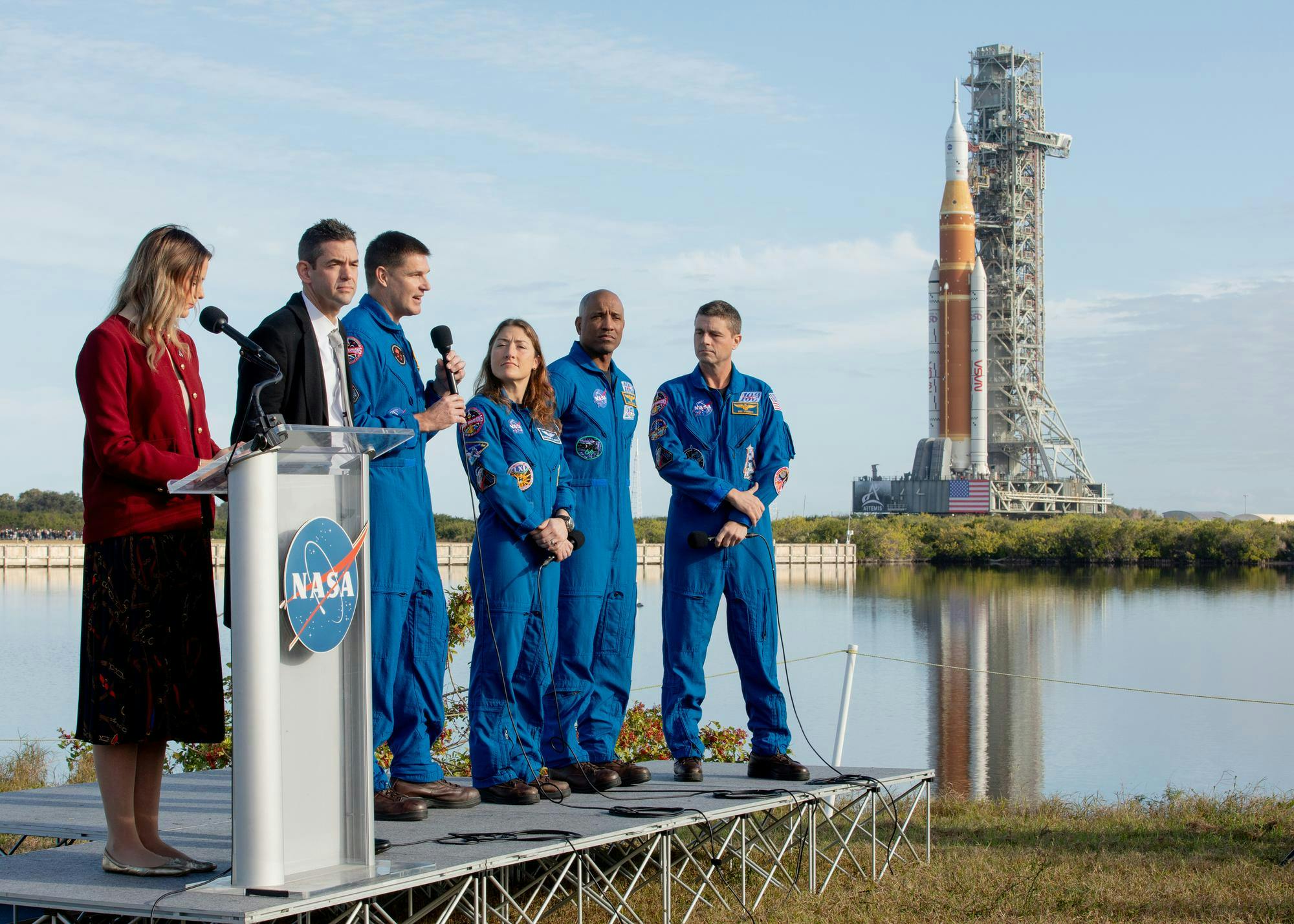
As NASA prepares for the next phase of its Artemis program, the agency is working toward returning astronauts to the Moon and establishing a sustained scientific presence there for the first time since the Apollo era in the late 1900s. The Sun spoke to Cornell students studying astronomy and astrophysics about this new advancement.
The first phase of the program, Artemis I, occurred in November 2022 and demonstrated that NASA’s new technology can operate in space. The next phase, Artemis II, is anticipated to launch in April. The mission will send four astronauts around the Moon and back to Earth, testing life-support systems and crew operations in deep space for the first time in more than half a century.
While Artemis II will not land on the lunar surface, it represents a critical step toward future missions that will return astronauts to the Moon and enable sustained scientific work.
“We have a plan for getting to the Moon and possibly Mars, but we don’t have the technology for [getting to Mars] yet,” said Alexis Anauo ’29, an astrophysics student interested in human spaceflight research. “Hopefully we will get to the Moon, establish a settlement and then build the technology to get to Mars.”
The program has faced technical delays and funding challenges, but third-year astronomy graduate student Aiden Zelakiewicz said that Artemis represents a major shift from short exploration missions toward long-term research in deep space.
“It’s a stepping stone and a launchpad,” Zelakiewicz said. Rather than producing a single dramatic moment, Artemis is intended to enable the larger discoveries that follow, he added.
Unlike the short, high-intensity missions of the Apollo Program – NASA’s series of missions that landed astronauts on the Moon between 1969 and 1972 – Artemis is structured as a multi-phase campaign, and its goals extend beyond planting flags or repeating history.
Through the Artemis program, NASA aims to establish a sustained human presence on and around the Moon, refine technologies for deep space travel and enable research that can only be conducted with astronauts working directly on the lunar surface, according to Zelakiewicz and Prof. Bonnie Teece, astronomy.
Human presence in space allows researchers to study how the extreme environment affects the mind and body, something machines cannot replicate.
“Robots aren’t experiencing the effects of space the way humans do,” Anauo said.
The first phase of the Artemis program already demonstrated that NASA’s new systems could safely operate beyond Earth. Artemis I, launched in November 2022, was a 25-day uncrewed test flight designed to evaluate the integrated performance of NASA’s Space Launch System and Orion Spacecraft, a capsule designed to carry astronauts on deep-space missions beyond low Earth orbit.
Designed to carry heavier payloads further than previous rockets, the Space Launch System will eventually enable human missions and new scientific observatories like the planned Habitable Worlds Observatory, a next-generation NASA telescope designed to directly image Earth-like planets around nearby stars and search for biotic chemical signatures associated with the presence of life.
Since telescopes capable of studying distant planetary atmospheres require extremely large, sensitive instruments, launching them may depend on powerful rockets like the Space Launch System. According to Zelakiewicz, the ability to launch larger telescopes may allow scientists to study distant planetary atmospheres with unprecedented detail.
Beyond enabling future telescopes and missions, Artemis is expected to transform how scientists study the Moon itself. Unlike Earth, where erosion and plate tectonics have erased much of the planet’s early history, the lunar surface preserves a record of the early solar system, Teece said. With astronauts able to select and return samples from a wider range of locations, researchers may be able to revisit long-standing questions about planetary formation.
"The moon is giving us a lot of important scientific information, but it's also acting as a training ground,” Teece said. Its proximity to Earth makes it easier to test technologies and research methods before attempting more complex missions further away, Teece explained.
Studying the Moon may also help scientists better understand how to search for life elsewhere.
According to Teece, studying an abiotic environment like the Moon can help researchers better understand the chemistry and mineralogy that make up lifeless bodies throughout our solar system and distinguish more clearly between signals produced by natural processes in these environments and those that may indicate biology. This knowledge will be critical for understanding signals of life for future missions to Mars and beyond.
With two phases of the program remaining, Artemis is also shaping opportunities for the next generation of scientists and engineers. Large programs such as these help sustain scientific careers and discoveries, Zelakiewicz said.
“These missions are some of our biggest public pushes of ‘look what we can do’,” Zelakiewicz said. “It gives perspective to society but also generates interest and trust in the scientific process that collects generations of work that culminate in these missions.”
Together, these efforts mark a transition from isolated missions to a sustained scientific presence in deep space. Rather than a single moment of achievement, Artemis is designed to create an ongoing system for discovery.
“We can’t always predict what we’ll learn, but we know we’ll learn a lot when we bring those samples back,” Teece said.


