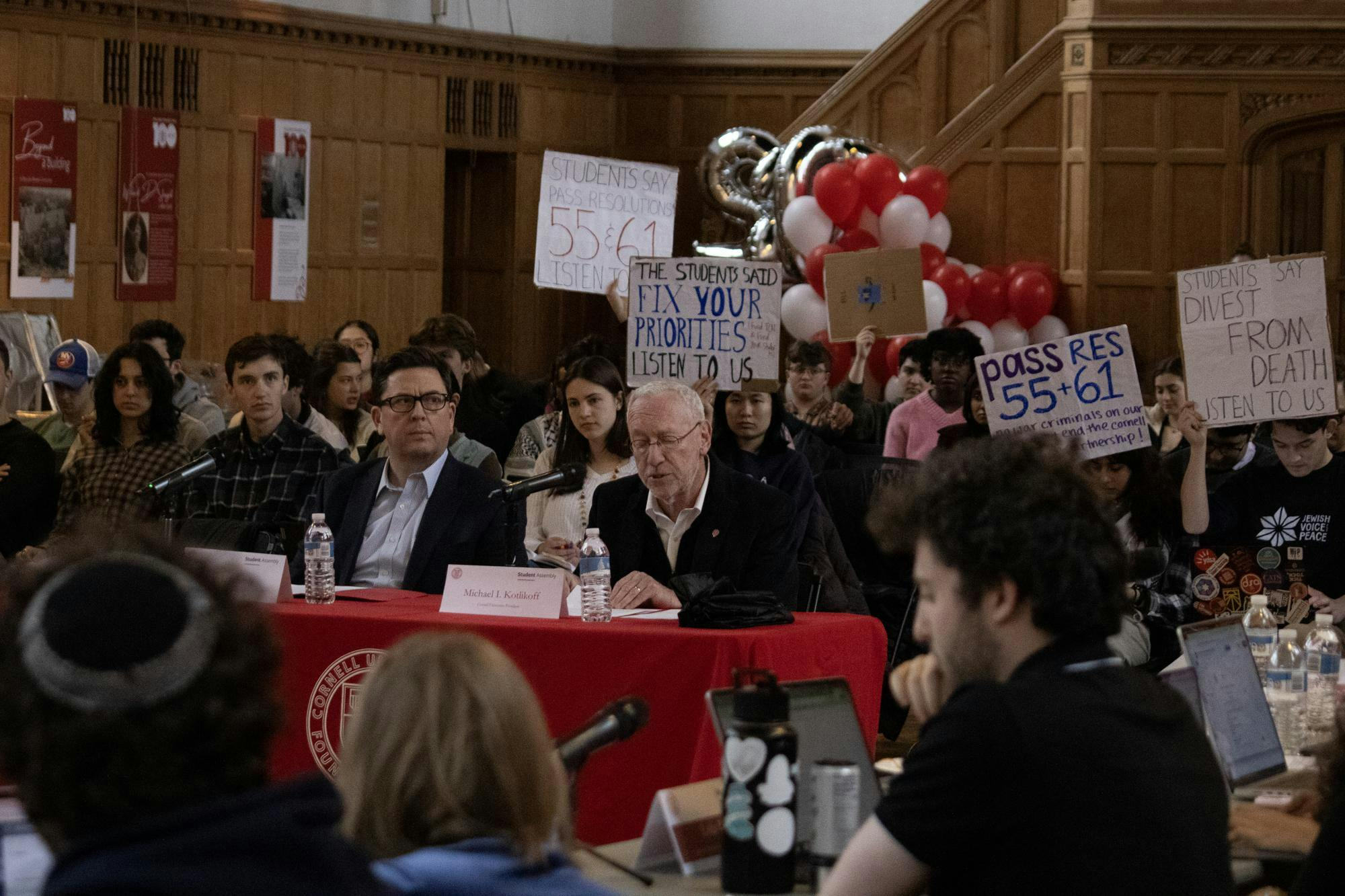
President Michael Kotlikoff and Ryan Lombardi, vice president for student and campus life, appeared before the Student Assembly Thursday evening amid a tense and crowded meeting in which students later debated two resolutions related to Cornell’s involvement with Technion and the invitation of alleged war criminals to campus — both of which ultimately passed by wide margins.
Kotlikoff and Lombardi attended the meeting to deliver remarks on the state of the University —including recent student protests, Cornell’s Expressive Activity Policy, the University’s Resilient Cornell initiative and his delayed responses to previously passed Student Assembly resolutions — and to answer questions from Assembly members.
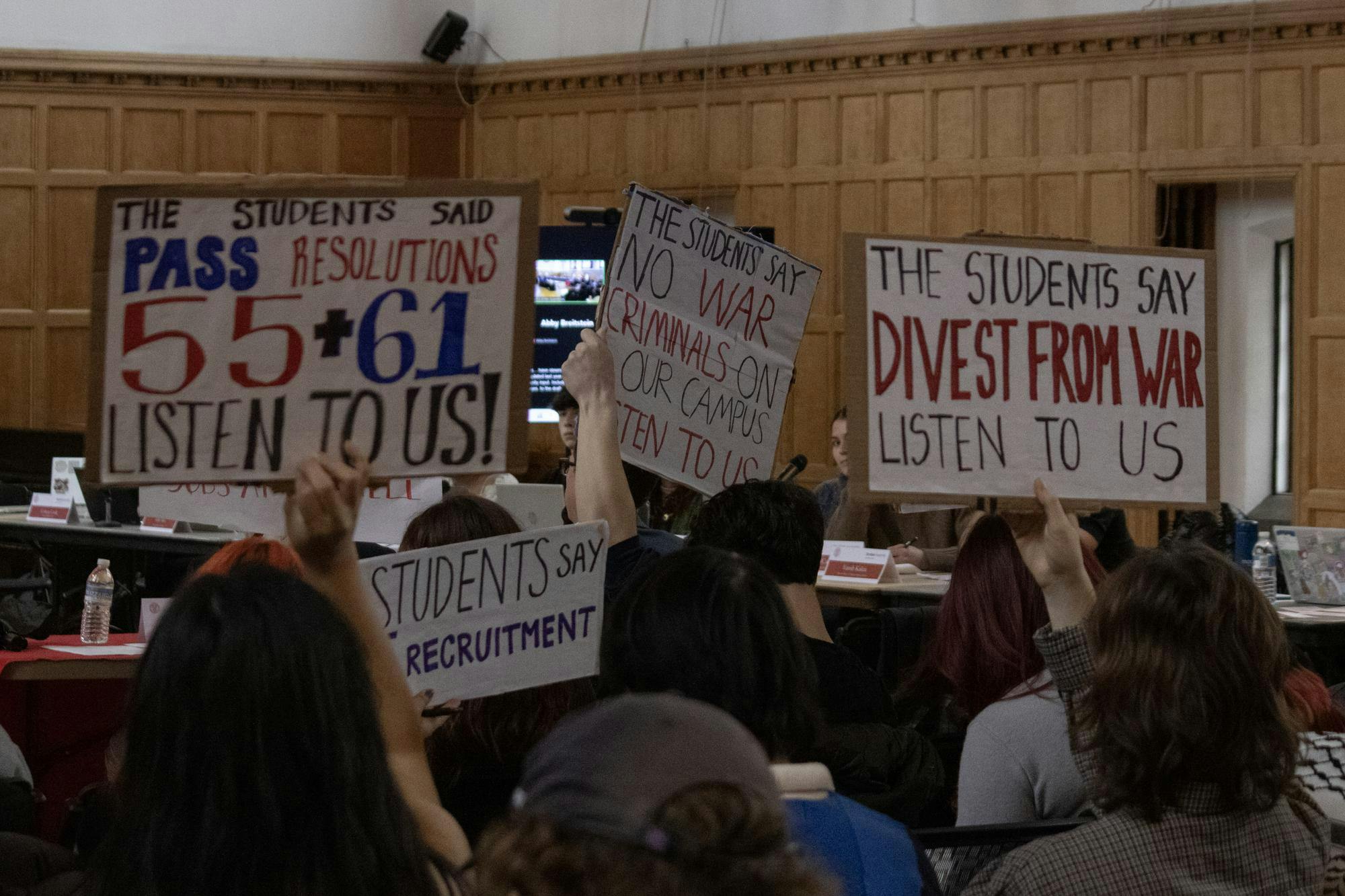
The room was packed with students, many holding signs as they prepared to weigh in during the public comment period on two controversial measures: Resolution 55 and Resolution 61.
Kotlikoff began the meeting with a roughly 10-minute prepared statement similar to remarks he recently delivered at a University Assembly meeting on Feb. 24. When discussing the administration’s partnership with the assemblies across campus, Kotlikoff spoke highly of the shared governance standard upheld by Cornell’s various bodies.
“Cornell has a long history of shared governance, dating back to the 1960s; it was and is part of our tradition,” Kotlikoff added. “It's an expression of our commitment to our core values and part of our educational mission, one of the ways we strive to educate capable citizens who go on to contribute meaningfully to a thriving democracy.”
Kotlikoff’s speech was intermittently interrupted by students in the crowd, who shouted and laughed at the president while he was delivering his address and during his responses to questions.
When Kotlikoff addressed concerns about the timing of administrative responses to Assembly resolutions, he explained that the volume of resolutions and narrow response deadlines could make it difficult to respond quickly. The time allotted for the president to respond is 30 days. Several students in the audience interrupted Kotlikoff during this explanation.
“Why has it taken you months?” one student shouted. “It’s your job,” another added.
After the interruption, Kotlikoff added that it was also “challenging to respond to resolutions that include inaccurate or mischaracterized information.”
Student Assembly President Zora deRham ’27 repeatedly called for order during the disruptions, reminding attendees that speaking out of turn or continuing to interrupt could result in their removal from the meeting.
After his remarks, Kotlikoff and Lombardi took questions from Assembly members on a range of topics, including student mental health, campus housing and the University’s policies surrounding divestment.
When one Assembly member raised concerns about student suicide rates at Cornell, asking how the administration was working both preventatively and supproting the students affected, Lombardi pushed back on the premise of the question.
“I do want to maybe offer one correction or comment about the suicide rate.” Lombardi said. “There are occasions when you've heard about a single death on campus where the cause of that death is not widely distributed. I know many people might assume that those are self-inflicted or suicides. That is not always the case.”
Lombardi added that “there have been a number of medical episodes” and the University needed to “honor the family's wishes in those situations.”
Lombardi also pointed to the University’s expanded investment in student mental health services over the past decade, noting that funding for those resources has increased significantly during his time at Cornell.
“In my tenure at Cornell, which is a little over 10 years, we've increased our mental health budget by 100%, so we've substantially grown mental health services,” Lombardi said.
During the questioning period, Max Ehrlich ’26, Industrial and Labor Relations representative to the Assembly, asked the administrators to acknowledge students standing behind them holding signs.
“I would like to direct both of you, just very briefly, to look at the signs behind you,” Ehrlich said. “These are students who have followed the [Expressive Activity] Policy and want to show you some actual messages.”
Kotlikoff and Lombardi turned to read the signs before Ehrlich continued with his question, prompting the president to reiterate Cornell’s policies governing campus protests.
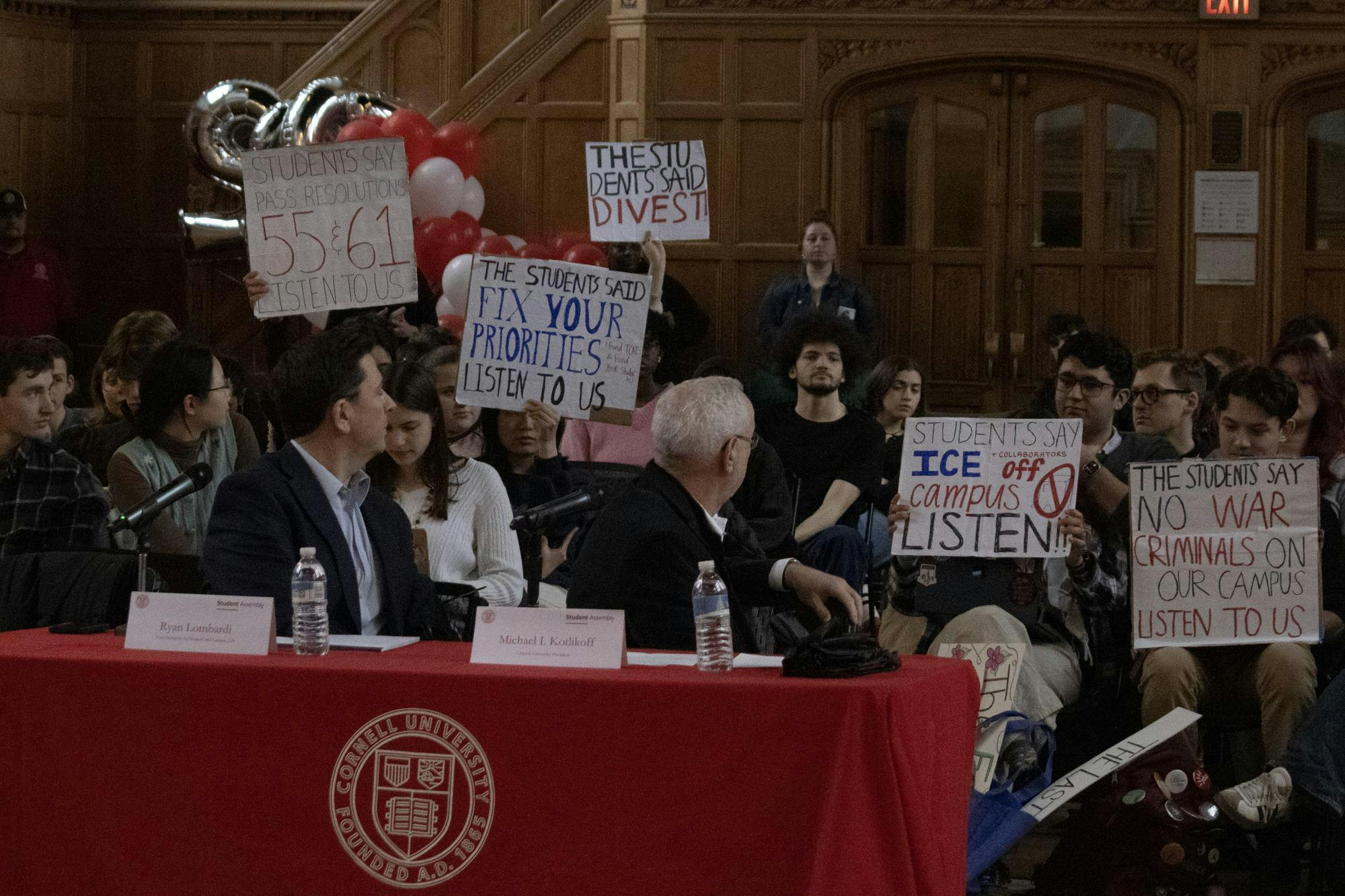
“I understand that certain people in our community don't like the fact that there is accountability for disrupting certain activities,” Kotlikoff said, addressing the Expressive Activity Policy.
One audience member shouted in response: “What about accountability for genocide?”
Following the Q&A period, Kotlikoff and Lombardi left the meeting to boos from members of the crowd.
The meeting then moved into a public comment period, which mainly focused on two proposed resolutions concerning Cornell’s institutional partnerships and University-sponsored programming.
Resolution 61: “Calling for the Termination of Cornell University’s Partnership with Technion – Israel Institute of Technology While Preserving Cornell Tech,” urges the University to end its institutional partnership with Technion while maintaining the operations of Cornell Tech.
Cornell Tech and Technion jointly established the Joan and Irwin Jacobs Technion-Cornell Institute, an applied sciences campus in New York City that offers dual master’s degree programs and a postdoctoral program.
The resolution cites ethical and legal concerns related to Technion’s alleged involvement in the development of military technologies connected to human rights violations.
“Partnerships with institutions that contribute to the production of weapons, military technologies, or infrastructure of apartheid are inconsistent with Cornell University’s stated educational mission, ethical commitments, and core values,” the resolution states.
Resolution 61 also calls for divestment from related joint programs and increased transparency in Cornell’s ethical review process for international partnerships.
Resolution 61 advanced to a third reading last week following another highly attended meeting, during which numerous speakers used the public comment period to express support for or concerns about the measure.
Resolution 55: “Condemning the University Administration’s Use of Programming to Platform Individuals Implicated in War Crimes,” criticizes the administration for hosting, funding or sponsoring programming that features speakers whom the resolution’s sponsors say have been “implicated in war crimes and grave human rights violations.”
The resolution references Tzipi Livni, former vice prime minister and former foreign minister of Israel, who participated in the University’s “Pathways to Peace” panel in March 2025. The event, which focused on the Israel-Palestine conflict and possible roads forward for Israelis and Palestinians, resulted in the arrest or detention of 17 pro-Palestinian protesters after they disrupted the event through shouting and coughing.
Livni faced war-crimes allegations and a warrant for her arrest in the United Kingdom in 2009 for decisions made before and during Operation Cast Lead while she was Israel’s foreign minister and a member of the Israeli security cabinet. The warrant was withdrawn after authorities determined she was not in the country.
Resolution 55 argues that hosting such speakers at University-sponsored events “endanger[s] student well-being.”
“Students are entitled to an academic environment free from militarization, intimidation, and the glorification or rehabilitation of individuals responsible for large-scale human rights abuses,” the resolution states.
Resolution 55 was delayed at last week’s meeting due to time constraints, as the Assembly was unable to get through to the second reading calendar after an extended public comment period focused on the two resolutions.
Ahead of the meeting, several student organizations — including Students for Justice in Palestine at Cornell, Cornell Young Democratic Socialists of America, the Kashmiri Cultural Alliance and The Progressives at Cornell — promoted attendance at the Student Assembly meeting through a joint Instagram post. In the post, the groups encouraged students to “pack the Assembly” and use the public comment period to urge representatives to support Resolutions 55 and 61.
Students speaking during the comment period expressed sharply differing views.
Mina Petrova ’29, a columnist for The Sun, argued in favor of Resolution 55, saying, “war criminals are not protected under free speech,” and that “one war criminal on campus is one war criminal too many.”
Others opposed the measure, including Jeffrey Lederman ’26, who argued that the resolutions risked restricting open debate.
“No university should be in the business of blacklisting speakers or severing academic partnerships on the basis of a political litmus test,” Lederman said.
Lederman further commented, saying, “The proper response to speech you disagree with is more speech, more dialogue, more debate. These resolutions choose the opposite path.”
Both measures ultimately passed Thursday night after nearly an hour of public comment.Resolution 55 passed with 19 votes in favor and 3 against, while Resolution 61 passed with 17 votes in favor and 5 against.
The resolutions will now be conveyed to the Office of the President for review.
Correction, March 19, 5:21 p.m.: This article was updated to correct the capitalization of Zora deRham's last name and include that Mina Petrova is a Sun columnist.
Vivienne Cierski is a freshman in the College of Agriculture and Life Sciences. She is a Sun Contributor and can be reached at vsc38@cornell.edu