

Since coming to college, I’ve found myself taking fewer pictures than I did in high school. My camera roll is filled with the same rotation of photos: the gorge frozen over, a sunset taken from the North Star Dining Room balcony and the chalkboard in my PSYCH 2090: Developmental Psychology lecture with notes I can never seem to write down fast enough. Any pictures I take feel more functional now; they hold less weight, less meaning.
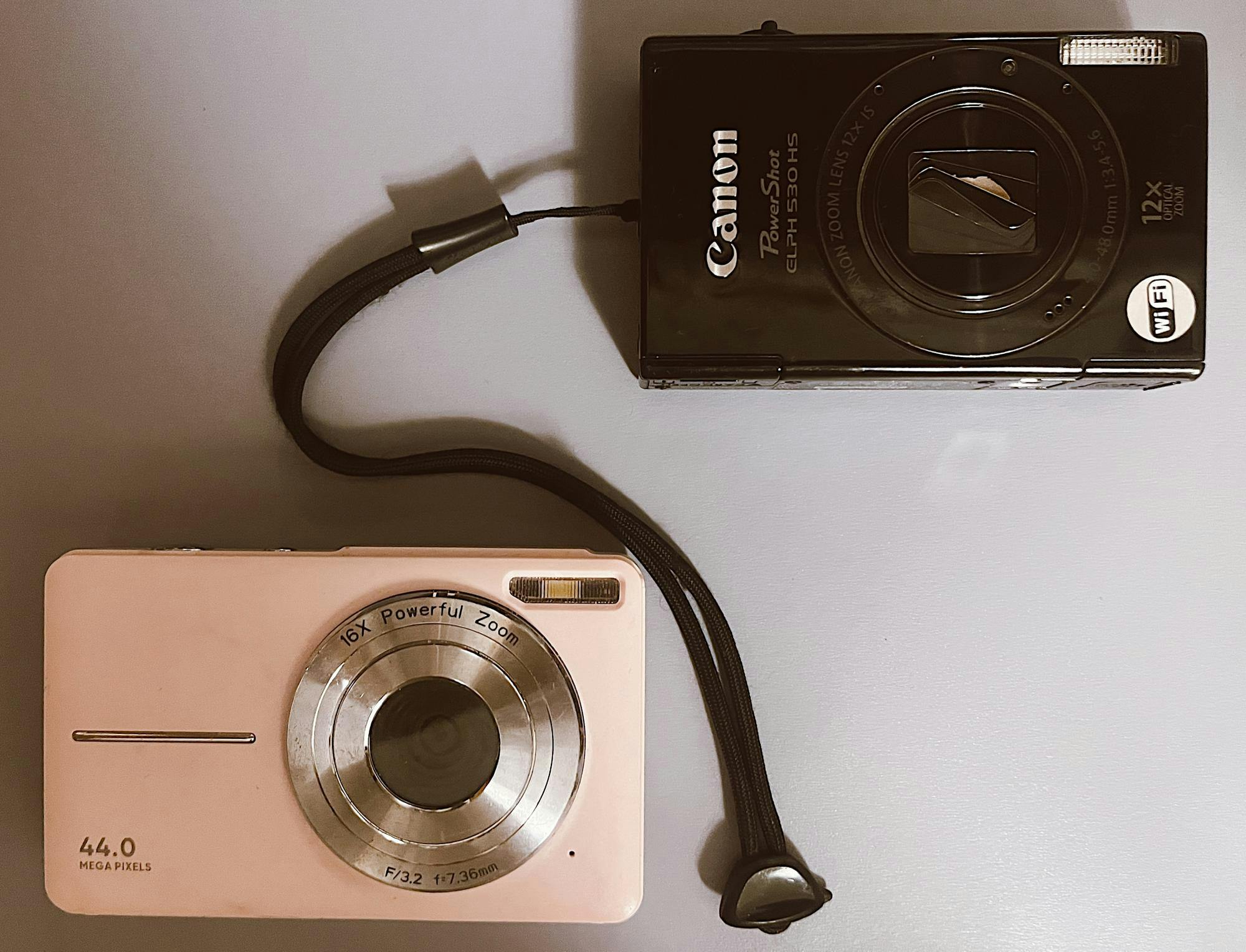
Over winter break, my older sister and I decided on a mutual gift — secondhand digital cameras from eBay. However, this agreement did make me stop and wonder: Why buy a camera when you already have one in your pocket? In a time shaped by social media fatigue — when every photo can be edited, filtered and instantly shared — there seems to be a quiet return to something older: the grainy, slightly out-of-focus photos taken on early digital cameras.
I remember flipping through printed photographs of my mother in her early 20s, meticulously placed into physical albums. I realized this kind of nostalgic aura feels unattainable through a mobile lens. The grain, the softness in low light and the slight blur of movement made each snapshot feel tethered to a broader moment in time. They lacked fine detail, but in that absence, there was something worth holding onto — something that made each moment feel deserving of being remembered.
That imperfection made the photos feel more real, less performative. Free from the harsh clarity of modern cameras — which push us to scrutinize how we look and how we might be perceived — these images didn’t demand perfection; they simply existed.
As someone born in the late 2000s, I recognize this same longing in my generation for the aesthetic of the Y2K era. The nostalgic quality of a digital camera evokes something subtly iconic — a glowing haziness that only lower-quality photos seem able to create. However, I don’t think this revitalization is solely about aesthetics.
For Shreem Chakravarti ’29, a student majoring in fashion design and management in the College of Human Ecology who works with Cornell’s Thread Magazine, the return to the digital camera reflects a shift in the photographer’s intention. Chakravarti explained, “I think the [digital] photos become more intentional and have a direction behind them, no matter the level of the photographer.” Since we use our phones for everything, she added, “that detracts from the feeling of taking the photo,” turning what could be deliberate into something routine.
She also connected the trend to digital exhaustion — the mental strain of constant screen use — and a desire to detach memory from performance. She explained, “There’s a desire to have candid, authentic photos that feel more connected to the moment.”
The appeal may also be tied to the memories many students grew up with. Chakravarti stated, “We see our old baby photos and our parents’ pictures taken on an older digital camera … that ‘look’ is associated with a nice memory.” Her reflection echoes my own experience flipping through my mother’s photo albums — the imperfect aesthetic becomes inseparable from the feeling of the memory itself.
As someone working in fashion and visual media, Chakravarti sees this nostalgia reflected in how students curate their images, adding, “Phone cameras are so high quality that it doesn’t always feel real to the eye. The way we view memories is more closely aligned with the grainy quality of an old camera.”
In creative spaces that are increasingly being reshaped by artificial intelligence, imperfection is more vital than ever. Chakravarti explained, “It makes the photos feel more human.” Even technically phone cameras often use a wider focal length than the human eye naturally sees. Many digital cameras more closely mirror our perspective, which may help explain why their images feel more aligned with memory than the hyper-clarity of our phones.
Her perspective reinforces what I’ve felt around Cornell’s campus: students are not simply chasing an aesthetic. They’re longing for photographs that feel intentional and rooted in memory.
We’ve grown accustomed to posing, to finding our ‘good side,’ to repeating the same smile in every solo or group photo we take on our phones. Taking a photo often feels inseparable from the question of how it will be received by online viewership. Will it be posted? Will it be liked? Will it be edited first? Using a digital camera feels different. It invites candor. It captures something raw and unposed, something taken without the immediate instinct to crop, filter or adjust. A camera reverts back to its original intention: a tool for documenting moments rather than performing them.
Chakravarti believes that the shift in intention changes how people behave in front of the cameras as well, explaining, “If the intention of the image is just for the photographer’s enjoyment, people become more creative and free.” She continued, “It is more fun when you take photos creatively and purely. … photos can capture magic in the scenery around.”
I’ve noticed this difference myself. When a photo isn’t destined for Instagram or immediate perception, the pressure dissolves. People stop rehearsing their expressions; the camera becomes less about documentation for others and more about presence for ourselves. That shift is what makes the photograph feel alive.
Amid social media fatigue, Cornell students’ return to older cameras feels less like a passing trend and more like a comeback to pure candidness. A digital camera invites intention; it exists simply to preserve a moment. A phone’s built-in audience carries expectations that can make even meaningful experiences feel staged.
Looking through those photo albums and scrapbooks of my mother’s youth, I felt something I wanted to hold onto, something I longed to see myself in. I want my own photos to carry that same sense of life being lived fully and honestly. I hope to someday flip through pictures of quiet nights, crowded dorm rooms, trips and ordinary days that felt important enough to document. I want to see unfiltered, candid smiles in every house, social circle and moment worth remembering.
Savannah Sandhaus is a freshman in the College of Arts and Sciences. She can be reached at sjs482@cornell.edu.
Savannah Sandhaus is a first-year in the College of Arts and Sciences. She is a staff writer for the Lifestyle department and can be reached at ssandhaus@cornellsun.com.


