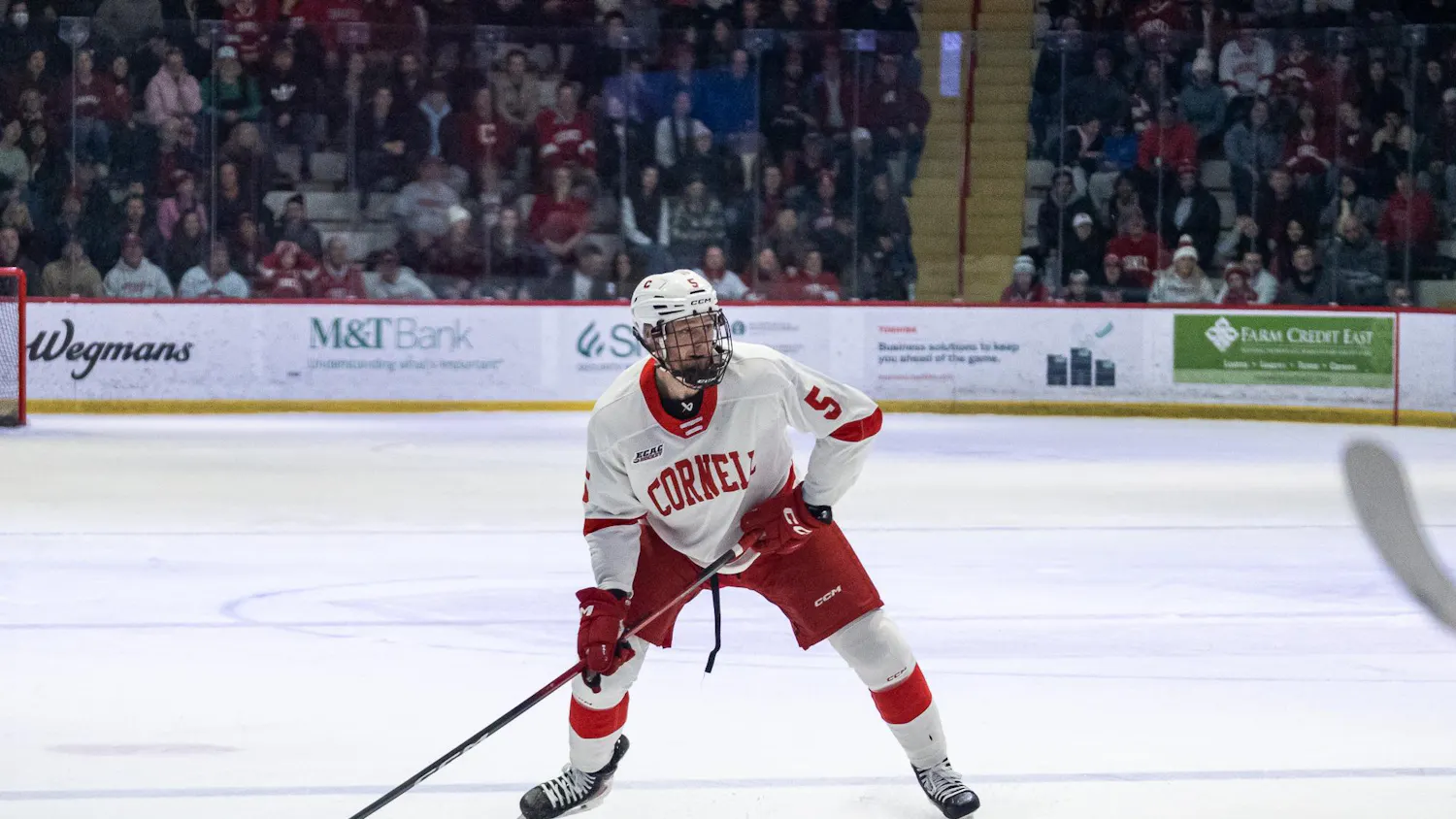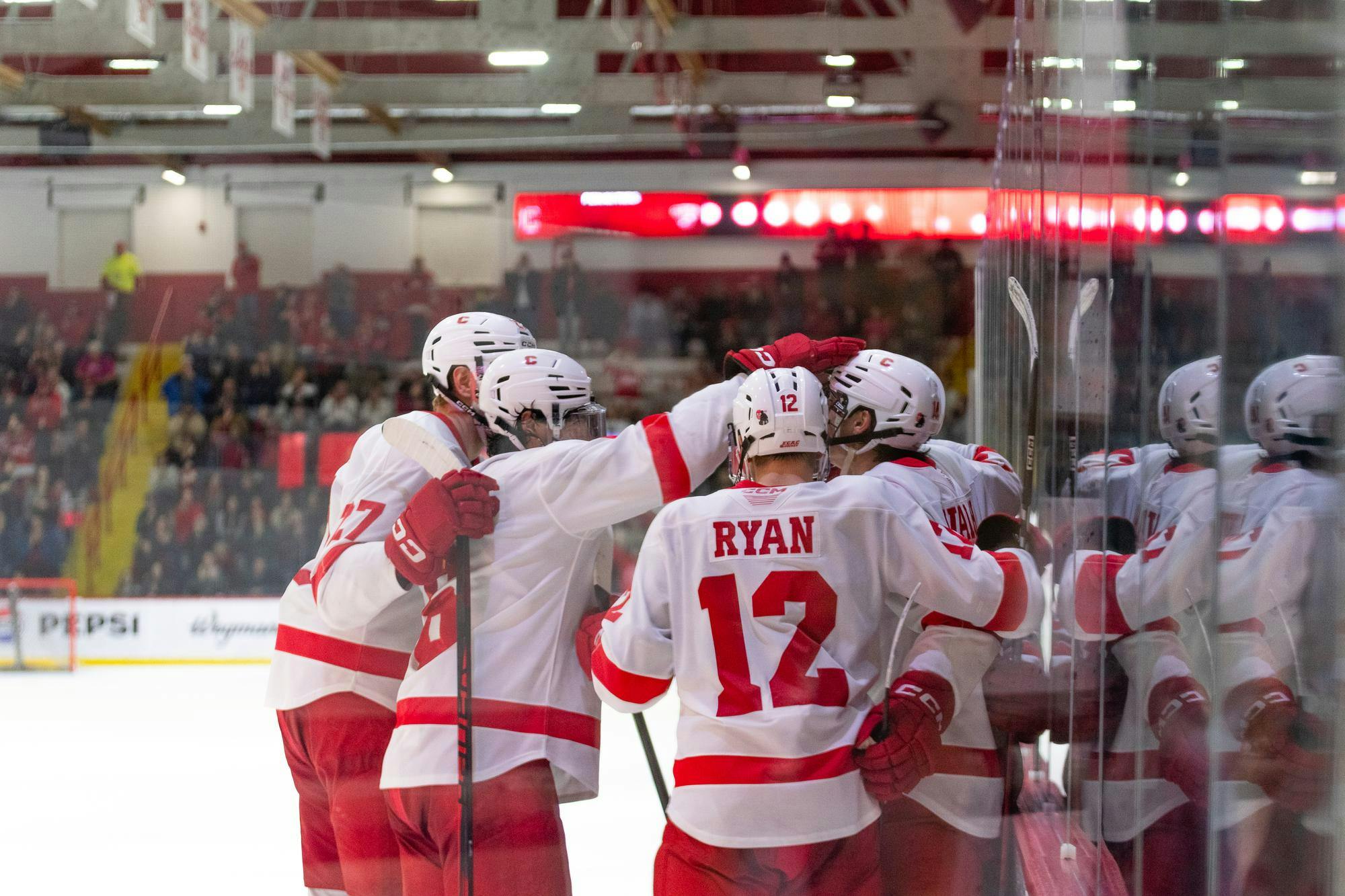
No. 9 men’s hockey is set to begin its defense of back-to-back titles this weekend when the ECAC quarterfinals are held at Lynah Rink.
Things will be a little fishy; visiting Ithaca is archrival Harvard, the second quarterfinal matchup between Cornell and the Crimson in just three seasons. Cornell’s and Harvard’s deeply rooted contention for one another spans decades, and recent iterations of the rivalry, particularly in the postseason, have yielded instant classics.
The third-seeded Red is in a comfortable position to clinch an NCAA tournament bid, and a couple of wins against the sixth-seeded Crimson should elevate its greater-than-99% chance of making the dance to a 100% guarantee.
So, in this postseason edition of The Sun’s men’s hockey mailbag, I will give my best answers to your questions as the team prepares for a playoff run. To leave questions for future mailbags or to receive the latest updates on Cornell men’s hockey, be sure to follow @JaneMcNally_ on X, formerly Twitter.
Questions have been lightly edited for clarity.
What aspect of Cornell’s game needs to be the difference maker in the playoffs? — @MrEd315
There are so many potential answers to this question — in the playoffs, everything carries extra weight. There is a need for good goaltending, strong special teams, clutch goal-scoring and sharpness on both sides of the puck.
For head coach Casey Jones ’90, the keys to beating Harvard lie in Cornell’s ability to limit turnovers and fend off the rush. The Crimson, Jones said, can make you pay for those unforced errors.
“[When] you look at our games we played against them, we turned pucks over in bad areas, and it's coming back to us as a scoring chance pretty quick,” Jones said. “You got to manage the game against them and make sure that they earn everything they get.”
When you consider the playoffs at large — beyond just this quarterfinal series — I’d point to discipline as something that must be in check for Cornell. It affects everything, from the ebbs and flows of the game, to the special teams battle, to the pressure put on the defense and goaltender.
There is no doubt that Harvard is going to head into Lynah Rink this weekend with an edge — the Crimson is playing for its season, after all, sitting 31st in the national percentage index and a potential spot in the 16-team NCAA tournament field contingent on winning the ECAC championship. Harvard is going to try to get under the Red’s skin much like Colgate did on Feb. 7 and Clarkson did on Feb. 25, both games that saw Cornell tally 25 minutes of penalties through 60 minutes of play.
Staying level-headed, composed and mature can be the difference between winning and losing with a young team.
Status of Luke Devlin — @LynahFan
Junior forward Luke Devlin has been out of the lineup since Jan. 24, and will remain out for the foreseeable future, Jones told me. Injuries are not typically disclosed publicly in the NCAA.
The team has its “fingers crossed” that Devlin will make a return before the end of the season. Having Devlin back in the lineup would provide a great boost in Cornell’s forward depth.
Hoyt Stanley is good to play? I haven’t heard about any suspension. Was rereading your preseason prediction in the special edition Cornell Hockey preview from October … you had us with 20 wins and finish 3rd in ECAC. How will the postseason end up? — @BlueLig08953021
Junior defenseman Hoyt Stanley did not face any supplementary disciplinary action following his game misconduct in Cornell’s regular-season finale and is good to go this weekend.
Well, good to know my prediction-making skills are spot on. You can find our preseason predictions here. As for the postseason, I’m no fortune teller, and the team is not taking its two-time title defense lightly. But make it to Lake Placid, and anything can happen.
The luxury that this Cornell team has, that others have not had in the past couple of seasons, is a nearly punched ticket to the NCAA tournament. Its top-10 position in the NPI puts it in solid position to extend its season despite the results of the ECAC playoffs. Whether that comfort in the standings affects the Red’s ability to defend its back-to-back titles, though, remains to be seen.
Castagna trade — more or less likely now for him to go pro? Also, can you convince him to stay? — @LynahFan
Re: Junior forward Jonathan Castagna’s rights being traded from the Utah Mammoth to the Calgary Flames in the big swap for NHLer MacKenzie Weegar.
It’s funny — in the immediate aftermath of the trade, I would have said less likely. The Flames have a deep prospect pool, including a grade-A assortment of NCAA prospects.
But in talking with Castagna, as well as sifting through all the media he has done in the trade’s aftermath, it’s no secret that things were not going to work out in Utah. Many have reported that Castagna likely would not have signed with Utah and instead tested NCAA free agency, as the Mammoth’s prospect pool includes a bevy of centers that are considered closer to NHL-ready than Castagna was — namely, at the 2025 NHL Entry Draft, Utah selected Caleb Desnoyers with the fourth overall pick, a high-upside center out of the Quebec Maritimes Junior Hockey League.
It’s not just Utah being less likely to sign Castagna — there is a desire coming from the Flames organization, too. Calgary’s director of player development, Ray Edwards, called Castagna “as pro-ready as they come,” though the Calgary Herald also noted Castagna would be finishing up the season and semester before weighing his decision of whether or not to turn pro now.
I won’t speculate any further — this is all reporting that is out there and that lines up with what I’ve heard.
I’m not sure I can do much about the second part of that question!
Expecting Cornell to be a 3 seed in the tournament, how strongly would you expect the committee to place them in Albany? It’s typically the prerogative of the committee to reduce flights and increase attendance. Also, should we be prepared for a postseason starting goalie battle? — @makin_Benjamins
Clarification before I get into the first question — this is referencing the NCAA tournament field, which Cornell is nearly a lock for at this time. Sitting at 9th in the NPI, the Red is likely to be a three-seed in whichever region it is placed in at the NCAA tournament (each region has four teams, seeded 1-4).
I have seen Cornell get projected everywhere except for Worcester, Massachusetts. Early Wednesday morning, USCHO.com released a bracketology that placed Cornell in Albany.
But this recent bracket projection by college hockey reporter Mike McMahon on his College Hockey Insider newsletter slotted Cornell in Sioux Falls, South Dakota. Yes, it is typically the prerogative of the committee to reduce flights and increase attendance — but Cornell might not be entirely prioritized as a No. 3 seed. Take a look at the before and after of McMahon’s projections, and I’ll explain further:
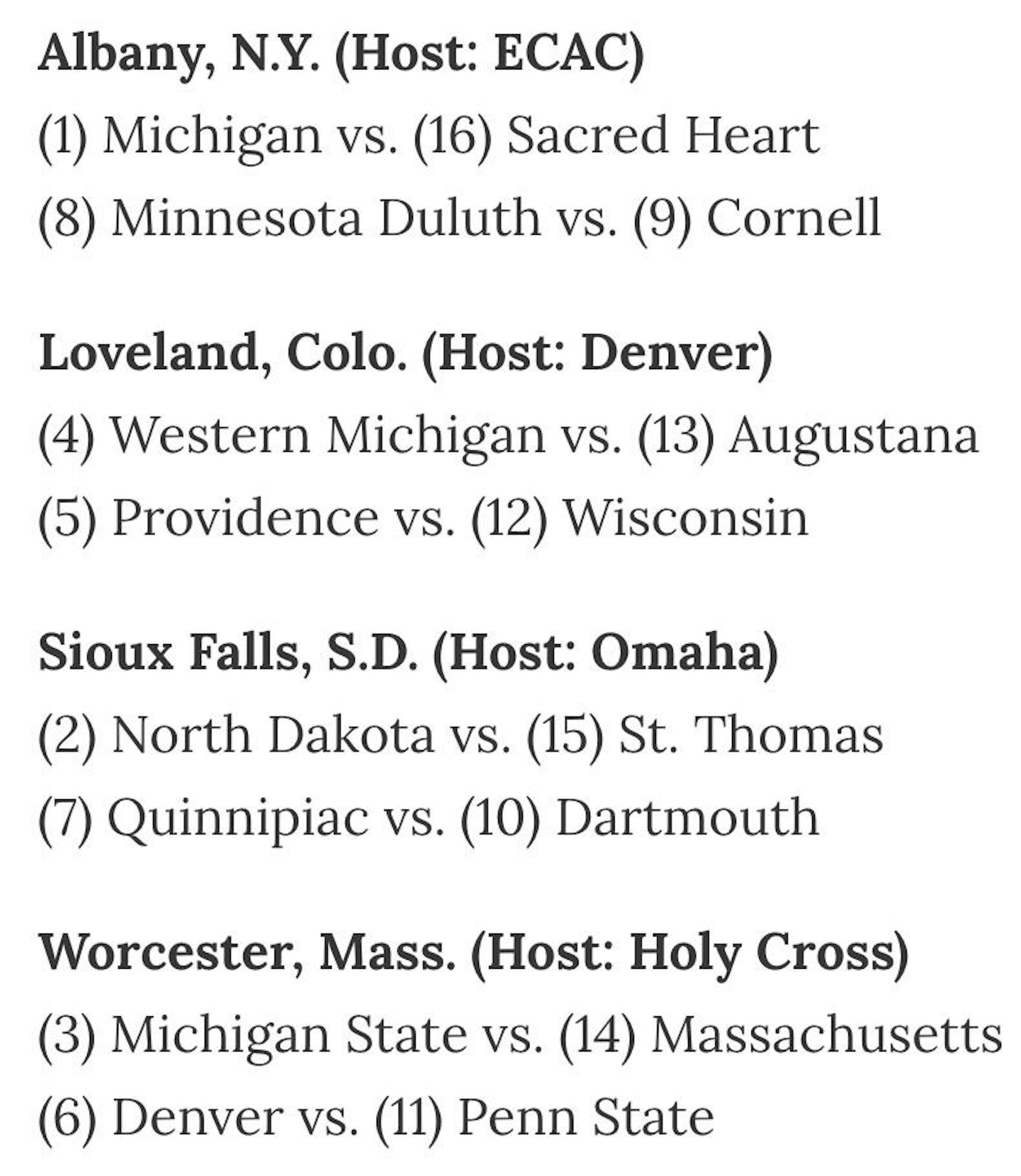

Problems with the left bracket: there is an intra-conference matchup in Sioux Falls (prohibited in the regional semifinal), and Denver is the host in Loveland, Colorado, so it must be placed there.
McMahon noted that Quinnipiac, as a No. 2 seed, could be awarded a near “home game” in Albany, so he swapped Quinnipiac-Dartmouth with Cornell-Minnesota Duluth (and then sending Dartmouth to Worcester in exchange for Penn State to break up the Q-Dartmouth matchup). These switches, although Cornell would have to fly to Sioux Falls, actually saves flights (teams within about a 400-mile threshold of the region are required to bus) — Quinnipiac and Dartmouth would be within driving distance of Albany, and Minnesota Duluth to Sioux Falls narrowly checks in at 392 miles by car.
This projection does make sense — it would leave three teams within driving distance of Albany, as opposed to two in the original projection. But Cornell could draw a significant crowd to the Capital Region, and I don’t think that’s worth ignoring — other mock brackets have projected Cornell in Albany.
Bottom line, it’ll just have to be a ‘wait and see’ type of situation — nothing can be solidified before the final NPI shakes out. And hey, if Cornell plays its cards right and wins out, and some other dominoes fall, the Red could even inch up to a No. 2 seed — then we could be having a different conversation. Cornell has a 36% chance of shifting up from a No. 3 seed to a No. 2, per College Hockey News.
As for your second question about the goaltending situation — it’s definitely an interesting one. I think freshman goaltender Alexis Cournoyer will be the starter — when in doubt, the staff has always leaned on its first-year netminder, who on Wednesday racked up Ivy League Rookie of the Year honors.
If things go south, though, Cornell won’t be afraid to put senior goaltender Remington Keopple in. The staff is confident in both netminders.
“Alexis has had the bulk of it, but we've had good goaltending throughout the season,” Jones said. “We've been pretty fortunate.”
What do you think has been the biggest difference between Casey [Jones] and Mike [Schafer] as coaches? Anything you notice from X’s and O’s, communication style, etc. — @scott_sports_t
I don’t think there’s anything I’ve noticed that’s fundamentally different. Of course, I’m not in the locker room (and practices are closed), so I can’t really speak to whether or how the day-to-day team dynamic has changed.
From what I know, Mike Schafer ’86 held his players to an extremely high standard — Jones does, too, but I think they communicate it in a different way. Schafer built the identity of the program around structure and accountability, and I think there was an obligation to uphold that on a day-to-day, minute-to-minute basis. For Jones, the goal to adhere to that longstanding identity is unchanged, but I think there will naturally be differences in communication and leadership styles when you are assuming a program rather than building from scratch.
As for on-ice differences, this is probably the fastest Cornell team I’ve seen in my time on the beat. I think there is a bit more emphasis on getting up and down the sheet quickly, while still upholding that same relentless forechecking and hard-nosed defense.
Jane McNally is a senior editor on the 143rd editorial board and was the sports editor on the 142nd editorial board. She is a member of the Class of 2026 in the College of Agriculture and Life Sciences. You can follow her on X @JaneMcNally_ and reach her at jmcnally@cornellsun.com.