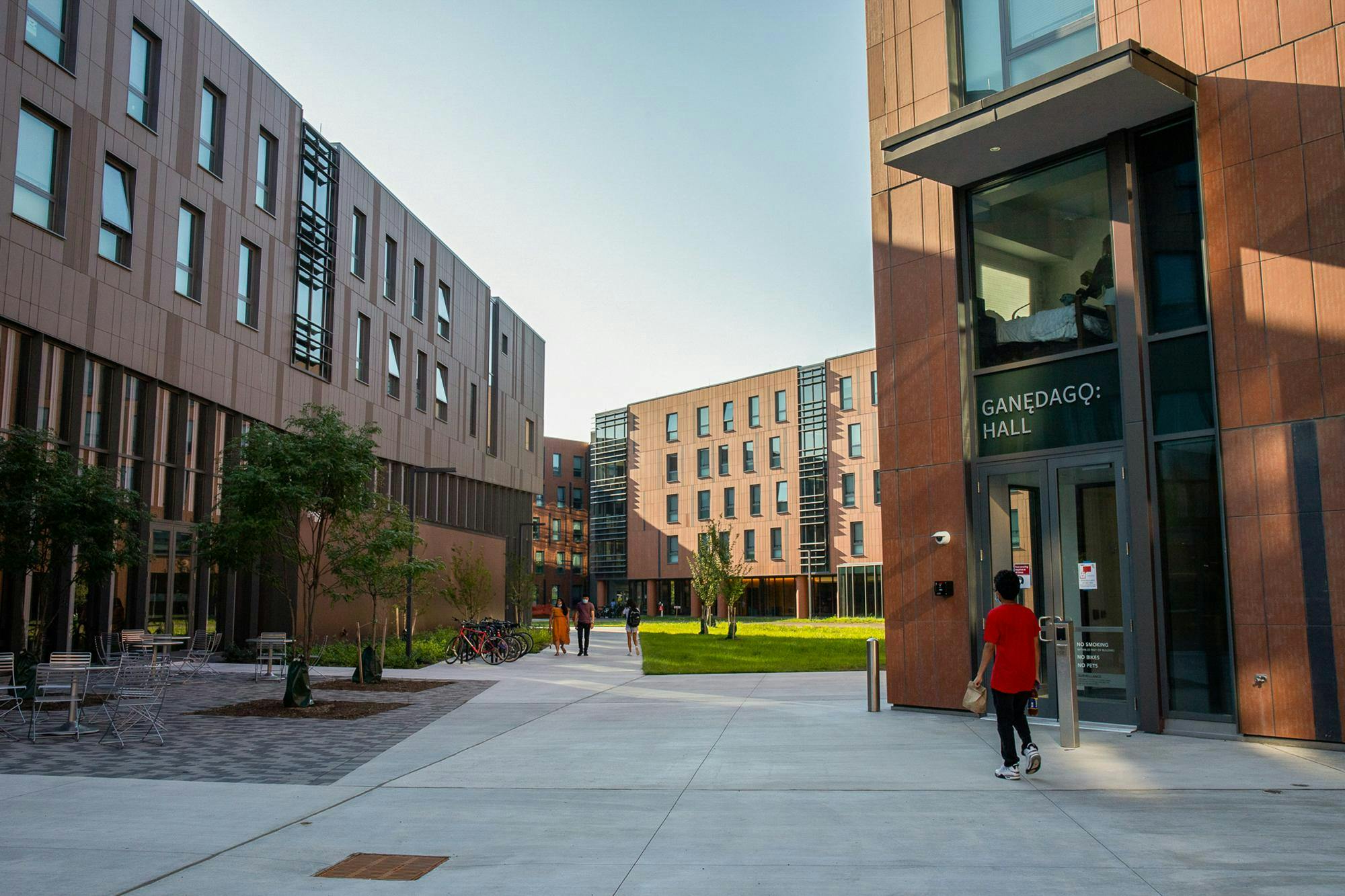
I was in line waiting to start recruiting for the philanthropy round of sorority rush when I got a text from my friend: “Your dorm is flooding BTW.” At first, I rubbed the text off as a joke — sharing a “LOL” with my friends — until I saw videos on Sidechat of water cascading down all five floors of Ganędagǫ: Hall, completely flooding the lobby. I didn’t know how to react.
At 9 p.m., I ran to Ganędagǫ, and I was told that I was being housed in the Statler Hotel for the night. I packed my things in my room, which thankfully wasn’t completely damaged (there was just a layer of water on the floor) — and my friend drove my suitemates and I to the Statler. The next day, I woke up graciously in the Statler’s king-sized bed and a plush robe to an email saying I had been moved to Carl Becker House. Additionally, the email told me I couldn’t stay in the Statler nor Ganędagǫ anymore. Minutes later, I received a text from my friend asking me to be interviewed about the flooding situation for The Sun.
Needless to say, I was livid — and I still am.
I can’t lie. Honestly, I was happy about moving to Becker. It’s considered one of the best dorms on campus and living on West Campus is much more convenient as a sophomore. Additionally, my dorm getting flooded was a ‘fun fact’ of mine for the first two months of this semester. However, I think I let off Cornell Housing too easily.
For one, I basically had to move all my stuff within a 24-hour period while balancing recruitment, which was impossible. I had to stay in my sorority house after being kicked out of the Statler, and the next day, my friend drove my bedding and I to Becker. I was so thankful that I had a source of alternative housing and friends with cars, and it made me think: What if I didn’t have these connections? While Cornell did provide free moving services with Student Agencies, these services weren’t available for a few days after the incident, so impacted students were essentially ‘homeless.’
Secondly, when I did move into Becker, the front desk student employee wasn’t aware that Ganędagǫ residents were moving in, and I had to suffer through an hour of explaining to an RA that I was a displaced person from my flooded dorm.
Lastly, Cornell did an awful job at accommodating. My suitemate in Ganędagǫ had to fight with Cornell Dining for three months and was even placed on hold for refusing to pay more for the House Meal plan, as she wasn’t on an unlimited meal plan in the first semester.
While I may be ‘beating the dead horse’ over a situation that happened three months ago, this situation reveals broader issues with Cornell. Why did Ganędagǫ, a building opened in 2021, flood even with new infrastructure? What is Cornell doing with our money? I, as someone who has a single, pay $7,501 per semester — all for my dorm to get flooded, and Cornell Housing was less than helpful during the immediate 24-hour move (other than giving me housing in Becker).
And this isn’t the only flooding situation that has happened this semester. After the Ganędagǫ flooding, both Toni Morrison Hall and Rockefeller Hall flooded in February from a “freezing event.” Students reported feeling “misdirected” and “uncertain,” during these situations, after being displaced from their classes and club meetings. Ironically, it’s now a reality for the average Cornell student to be wary of water pouring down on their heads in any Cornell facility.
So, Cornell, what exactly does our tuition fund? Forget about Cornell funding basic necessities — free laundry, gyms facilities or air conditioning. What about the very integrity of the buildings we sleep, study and live in? What about student accommodations in the face of emergencies? If we can’t even trust living in a building that’s only three years old or a building that has been here since Cornell’s founding, why does Cornell expect its undergraduate students to live on campus for two years — and pay thousands of dollars to do so?
As first-year housing selection begins and students begin picking out sophomore-year housing, I’d recommend students to be wary of anywhere they choose. Newer dorms can easily break down like older dorms in the winter or spring, and accommodation options are bleak from the University. Before moving into any facility, make sure to have a plan on what to do in case of an emergency — who to contact, what to collect from your room and friends who would be willing to help. At Cornell, I’ve come to realize the grim reality that Cornell will never help in the ways you want them too; usually, it’s your community that has to rise to the occasion.

Sanika Saraf is a member of the Class of 2028 in the School of Industrial and Labor Relations. She is an assistant Lifestyle editor on the 144th Editorial Board and can be reached at sanikas@cornellsun.com.