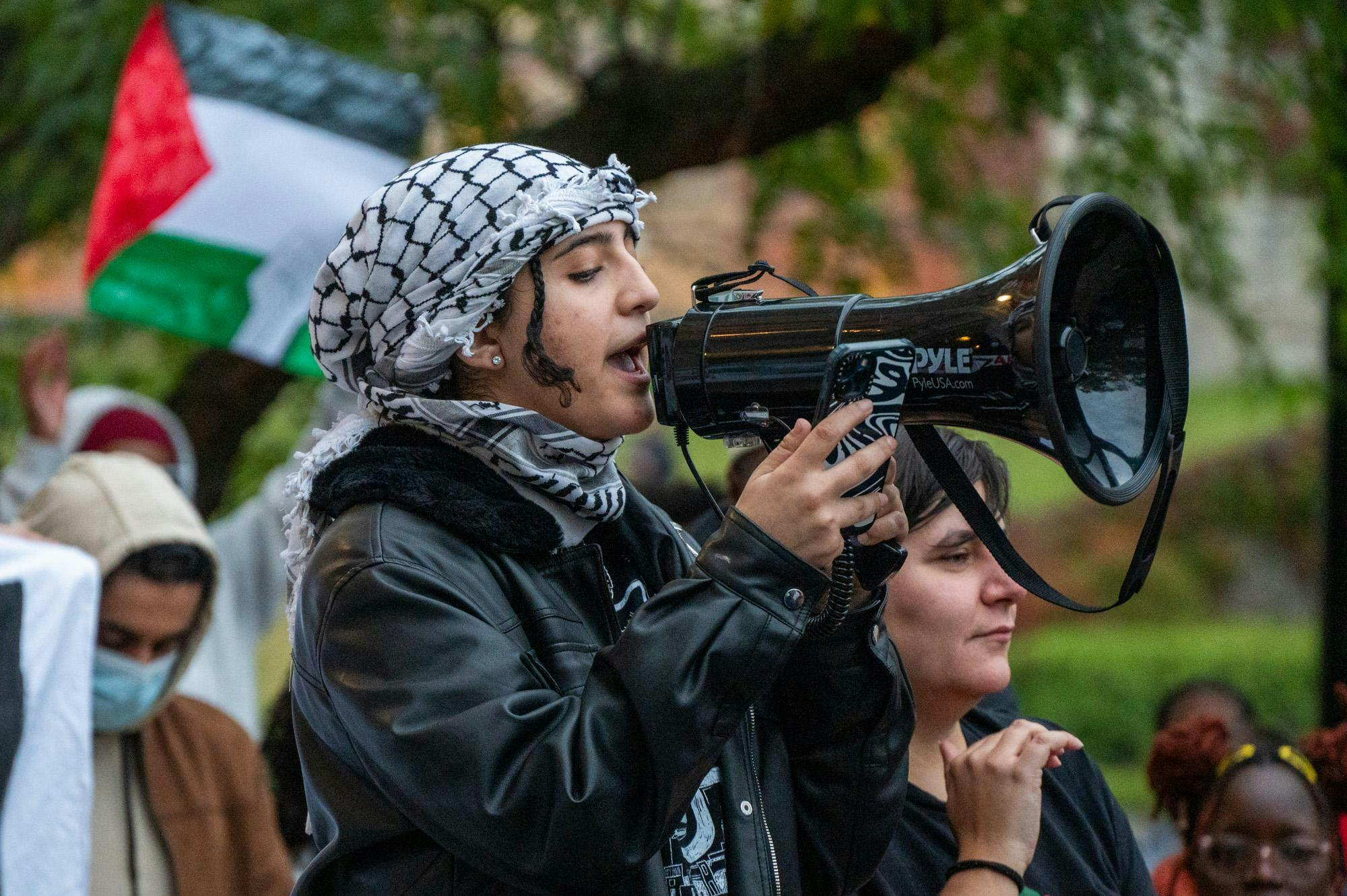
Malak Abuhashim ’24 M.Eng. ’24 will speak at an “Alumni Activist Panel” on Wednesday, hosted by Students for Justice in Palestine at Cornell and The Progressives at Cornell, sponsored by Gender Justice Advocacy Coalition and affiliated with Muslim Educational and Cultural Association and the Kashmiri Cultural Alliance.
The event will feature a moderated panel and a Q&A session according to CU Progressives and SJP, and will discuss “her experiences as an organizer in and beyond Cornell” and “the intersections of being a Palestinian Muslim Cornellian woman,” according to an Instagram post about the event, which will be located in room 132 in Goldwin Smith Hall at 6 p.m.
Prior to the announcement of the panel, Abuhashim posted a video of an individual shooting a can with a BB gun with the caption "Training to liberate Falasteen inshallah” on her private Instagram account according to the Instagram story obtained by The Sun. Abuhashim overlaid an inverted red triangle emoji above the can.
“The post was made on my private Instagram story. It's from two weeks ago, and I made it as a joke,” Abuhashim said about the video. “As a Palestinian American with my family in Gaza that is currently being bombed in refugee camps, struggling to survive this genocide, it's really hard for me to exist, and one of the ways that I cope with the situation is through humor. And so I tend to make dark jokes or use humor to express situations, especially because of how daunting and tragic and traumatizing it is to be experiencing this.”
The inverted red triangle is a symbol used by many pro-Palestinian activists, according to Al Jazeera. The triangle appears in the Palestinian flag, and “first appeared in Hamas videos to indicate targets such as Israeli tanks,” Al Jazeera reported.
Because of its origin, some consider the symbol to represent support for Hamas or antisemitic sentiment.
“The inverted red triangle has, in many cases, come to signify support for violent Palestinian resistance against Israel and against Zionists and Jewish people more broadly,” according to the Anti-Defamation League, though "context must be considered when determining whether use of the inverted red triangle represents support for Hamas: because part of the Palestinian flag is a large red triangle, some users may see it as a harmless symbol of support for Palestine and use it accordingly," the ADL added.
“To me, [the red triangle is] a symbol of Palestinian expression,” Abuhashim said in an interview with The Sun. “The triangle is in our flag. There's a lot of different emojis I use for representing Palestine. There's the watermelon, there's the Palestinian flag and I feel like the triangle is more of a trendy, edgy emoji.”
Abuhashim said that the events in Gaza should be given more attention than her response to them.
“My family in Gaza is facing a genocide where the Israeli army is killing them in refugee camps, bombing the refugee camps literally 24/7, erased Rafah, the city that my family was residing in,” Abuhashim said. “But then my reaction is somehow worse than the actual reality that we are living through. The attention is not on what the f*ck are we allowing to happen to these people in Gaza. The attention is not on the atrocities that are happening to my family. The attention is how am I reacting to my family dying, and I don't think that's fair.”
The conflict in Gaza was labeled a genocide on Sept. 16 by the U.N. Independent International Commission of Inquiry on the Occupied Palestinian Territory, who reported that Israel committed four of five genocidal acts against Palestinians according to the 1948 Convention on the Prevention and Punishment of the Crime of Genocide.
Abuhashim has personally experienced harassment as a result of her activism for Palestine.
“I'm very heavily scrutinized with everything that I say or do or post,” Abuhashim said. “There have been campaigns against me on social media. They've gotten my phone number and threatened me. They've gotten my family's phone numbers and threatened them.”
In addition to safety concerns related to her activism, Abuhashim said that her activism prevents her from visiting her family in Gaza.
“Israel controls who gets into Gaza and who is allowed into the West Bank, and by me speaking out for Palestine, essentially, I'm not allowed to go back because I'm a security risk,” Abuhashim said. “At the end of the day, all I really want is to be able to see my family in Gaza … I'm praying that part of liberation is that I can return.”
GJAC, a co-sponsor of the panel, wrote to The Sun, “GJAC acknowledges the video, however, we were not previously aware of it. Based on the information provided by The Sun, that video would have been posted after funding was approved for this event, and seems to have been posted on a private account that none of our e-board have access to. GJAC’s decision to fund this event was a result of the information we had at the time the application was submitted.”
When asked about the event and Abuhashim’s Instagram post, CU Progressives and SJP did not acknowledge the post.
“We’re excited to host Malak Abuhashim to speak to our organization and other cosponsors about her perspective and experiences as a Palestinian American woman and a former Cornell student activist,” CU Progressives wrote to The Sun.
“Students for Justice in Palestine at Cornell is honored to be hosting our former President, and Gazan-Palestinian-American, Malak Abuhashim to speak on her past and present experience as an organizer. The event will include a moderated panel and a Q&A section. We look forward to learning from Malak’s perspective and being inspired to continue the movement for a free Palestine at Cornell,” SJP wrote to The Sun.
MECA and KCA did not respond to comment regarding the event and Abuhashim’s post.
Abuhashim emphasized that the event is open to everyone regardless of “whether you understand and support Palestine or not,” in a statement to The Sun.
While a student at Cornell, Abuhashim said that she and other Palestinian and Muslim students on campus experienced harassment and doxxing. In 2024, one Muslim student was spat on in Collegetown, and there were instances where hijabi women were followed after prayer.
When Abuhashim and several others met with Marla Love, Robert W. and Elizabeth C. Staley dean of students, and Ryan Lombardi, vice president for student and campus life to discuss their concerns and provide actions for administration to take regarding the incidents, “they didn’t do anything,” Abuhashim said.
“I have a message to Cornell administration, to President Kotlikoff, to Ryan Lombardi, Marla Love: I would love for them to attend this event,” Abuhashim said. “I would love for them to take the time and listen to a Palestinian student about what it is like to be on campus and address me and hear my story.”
The University did not respond to comment regarding Abuhashim’s experiences with Cornell’s administration.

Coral Platt is a member of the Class of 2029 in the College of Arts and Sciences. She is a staff writer for the News department and can be reached at cplatt@cornellsun.com.