Voting for this year’s Student Assembly election ends today. By tradition, this is around the time our Editorial Board would tell you which candidate for president and which candidate for executive vice president we believe deserves your vote. After interviewing each of them and weighing their platforms against one another, we would make a recommendation grounded in The Sun’s institutional values that one of them, on balance, would govern our student body better than the rest. We have chosen not to do that this year.
None of the candidates we interviewed, in our judgement, has put forward a complete enough vision of the office, with sufficient grasp of what the Assembly can and cannot actually do, to earn the full confidence of this Board. To endorse the least-objectionable option would be to suggest that the floor for our endorsement is meeting a bare minimum, and we do not think that is the standard the student body should accept from the people elected to represent it.
What we have chosen to do instead is to endorse policies. A handful of the proposals we heard across our interviews and across the candidates’ public forums struck as urgent and worth the new Assembly’s attention regardless of who occupies its two seats. This endorsement is not aimed at the students who have already cast their ballots, whose minds were made up before voting opened, we are not in the business of changing these peoples’ votes in the final hours of the election. This editorial is aimed at roughly nine in 10 undergraduates, who in last year’s race, did not vote at all, and at those who see Student Assembly as a body whose meetings happen somewhere on a Thursday night and whose resolutions arrive in their inboxes, if at all, as something to delete.
The case we want to make to those students is that the policies detailed below are the kind the Assembly can plausibly deliver, that delivering would meaningfully improve the conditions of being a Cornell undergraduate student and that the question of who is elected to push for them, is accordingly, worth a few minutes of your attention before voting closes.
The Fragility of Shared Governance and Its Effect on Our Judicial Systems
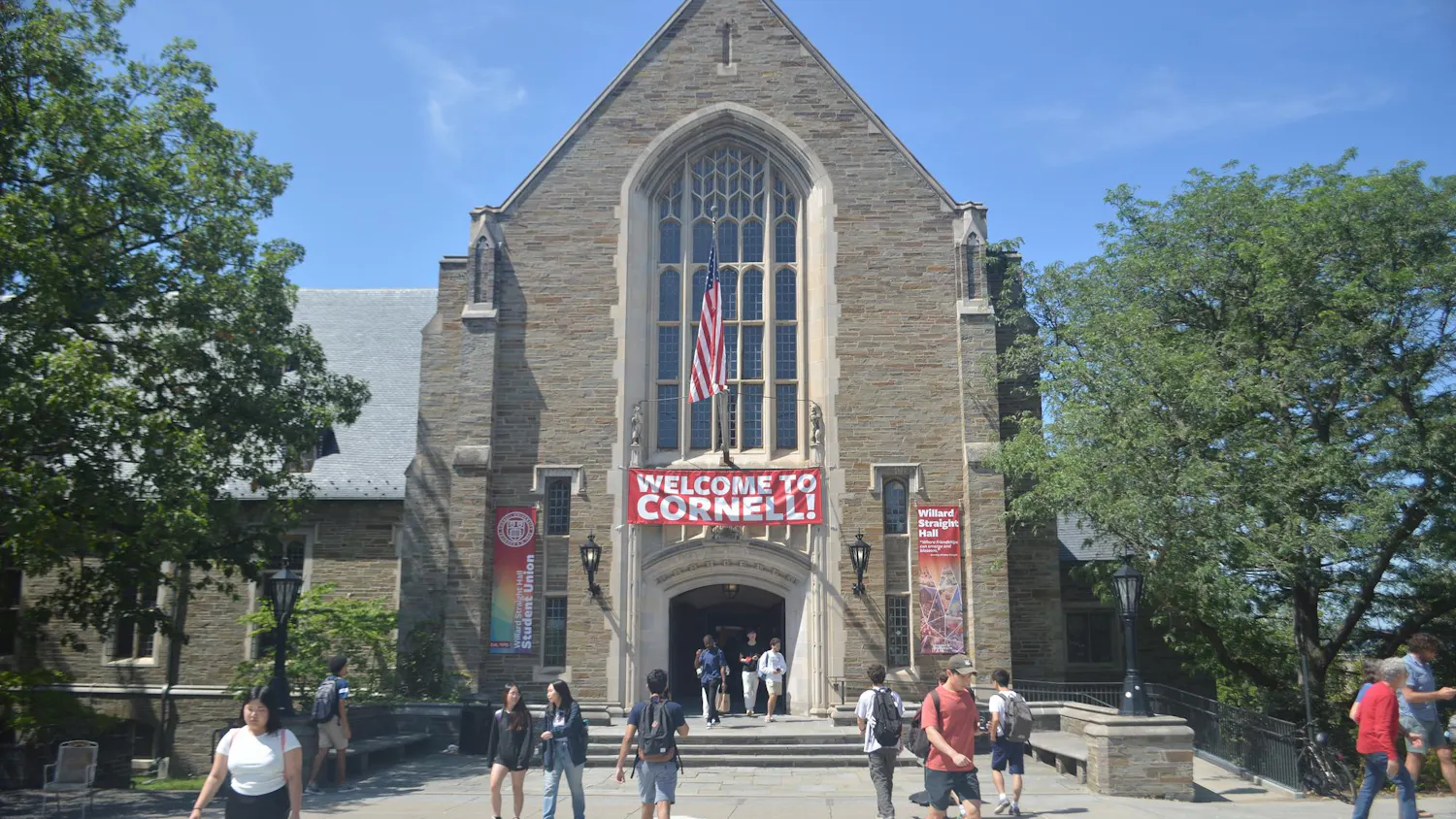
Shared governance is the principle that the people governed by the University’s rules should have a hand in writing them, and at Cornell, this principle is no courtesy, it is a concession, won by Black students in the 1969 Willard Straight Hall Takeover and codified in the campus-wide Code of Conduct and the independent Office of the Judicial Administration that governed student discipline from 1969 until 2021. The University Assembly, the Faculty Senate and the Student Assembly all exist because of that concession. Their authority over the Code in particular existed because students in 1969 knew that a university that can serve as the complainant against its own students should not be able to sit in judgement of them, and such authority existed until 2020, when it was traded away through a Student Assembly resolution circulated two hours before a University Assembly meeting at which it passed and was debated for roughly five minutes.
What that trade produced is now visible in the cases our News and Opinion sections have spent the past year documenting. The average time between a temporary suspension and the resolution of a student’s case has been reported at 246 days, which is to say that any student suspended in September can expect to wait until commencement before learning their fate. Interim suspensions, once reserved for extraordinary circumstances are not imposed at administrative discretion and appealable only to the Vice President for Student and Campus Life, whose office, by our reporting has not approved a single appeal. Dina Ginzburg, a second-year graduate student in the School of Industrial and Labor Relations, was found “not responsible” by a hearing panel in February for for three alleged Student Code of Conduct violations stemming from the Pathways to Peace event in March 2025, 11 months after the Office of Student Conduct and Community Standards opened its investigation. Although, Section 18(b) of the Student Code of Conduct Procedures requires investigations to be completed “as expeditiously as possible,” our reporting documented months of delays, an arrest predicated on inaccurate police reports and excluded evidence. Adriana Vink, in a column for this paper, described the process by which she was confined to her dorm for weeks after the same event, advised by her own resolution coordinator that filing an appeal would be a waste of time.
In December, nearly 3,000 undergraduates voted in favor of the two referendum questions calling for Cornell’s disciplinary system to be made independent and for the campus-wide Code to be reinstated, both passing by margins above 90%. President Micheal Kotlikoff was required by the Assembly’s charter to respond within 30 days. After revisiting issues with the email voting link, in a Feb. 2 response, President Kotlikoff acknowledged the referendum but there have been no other movements. Now, four months later, what we have is a Codes and Procedures Revision Committee whose membership is more than half administrative, and a draft that does not address either referendum question.
In our interviews with the candidates, every contender for president and executive vice president named some version of this problem, though they diverged on what to do about it. Presidential Candidate and current Executive Vice President Christian Flournoy ’27 has built his platform around what he calls the “resolution life cycle,” with meetings between the student body and University leadership discussing the resolutions before they are passed. Presidential Candidate and current University Assembly Student Representative Eeshaan Chaudhari ’27 argued for “building teeth” into resolutions through binding clauses and for coalitions that pull in alumni and the Board of Trustees alongside the elected Assemblies. Presidential Candidate and the current Student Assembly President Zora deRham ’27 is one of the undergraduates currently seated on the Codes and Procedures Revision Committee, told us that she was not aware of her appointment until close to the start of the school year, missed the majority of committee meetings because of her class scheduled and concluded that conveying “assembly sentiment" in the room was not enough to produce real edits.
Executive Vice President Candidate and current Vice President of Finance Hayden Watkins ’28 has been the most explicit that pressure inside Cornell, is not on its own sufficient, and has pointed to the Ivy Conference and the SUNY Student Assembly as external venues where the body’s coordination has atrophied. Executive Vice President Candidate and current Vice President of Diversity, Equity and Inclusion Kennedy Young ’28 speaks to the issue of the Assembly’s authority in a statement to The Sun. She concedes that many “resolutions fall outside of the Assembly’s direct authority,” however she plans to improve follow-through by “meeting with administrations during the drafting process.” She also plans to “continue pushing for data requests within the Assembly's direct purview” in areas such as housing, student life and student services.
Whichever candidate students choose, the seats require a willingness to spend time and political capital on a fight whose timeline does not align with a one-year term. The lesson of 2020, when a five-minute debate on a resolution circulated two hours before a meeting cost students nearly 50 years of judicial independence, is that powers given up are not given back. The next Assembly’s first job is to make sure no further ground is lost on its watch.
Internal Accountability and Making Student Assembly More Accessible to Students
Student Assembly meetings often go unnoticed by large swaths of the Cornell community, many of whom do not know that they are happening, or simply do not see the link between the weekly proceedings and changes to their campus life. On the Assembly side, meeting minutes have gone unpublished from Assembly meetings weeks ago and committee rosters include outdated names. The combination creates an environment of inaction and indifference both within and without Student Assembly. Such an environment internally undermines the concept of shared governance, as the Assembly doesn’t even noticeably exercise the powers it still has.
Almost all of the candidates acknowledged the Assembly’s lack of engagement with the Cornell community, but believed it stemmed from different sources and offered varying solutions. Chaudhuri bluntly blamed internal interpersonal divisions within Student Assembly for the inaction, saying that “people genuinely hate each other on Assembly” and that “they view it as a place where they can go and yell at each other and go and really despise each other for their different viewpoints.” He promised to improve the Assembly’s culture by “shaking everyone’s hand, regardless of if I voted for them or not.” He also wanted to see “one outreach event a day for the entirety of the year” by having “30 different members of the Student Assembly having their own individual constituent outreach event a month.” deRham said that a “peer accountability process” with the Office of Ethics and “motivating someone to run against them [the inactive member]” would be potential solutions to the “incredibly inactive Executive Board,” which she cited as the main cause of the negative perception of Student Assembly. While she expressed that she would work behind the scenes to enact the change she wants to see in the Student Assembly, she also said she’d simply “hope” for improvement.
Watkins proposed “publicizing Student Assembly’s under-accessed resources,” such as the emergency grant that provides for unexpected costs for students and the infrastructure fund commission. Fixing the minor problems people experience across campus, such as a lack of bike racks, and putting a “funded by the Student Assembly” sticker would help alleviate the perception of Student Assembly as a powerless entity. Young wrote in a statement to The Sun that improving communication is the key to rebuilding trust and wanted to “make sure Assembly members are doing more to get out there.”
Regardless of who is elected, internal divisions and inefficiencies are the first ailment that must be addressed. Proving that the Student Assembly is internally effective at addressing the concerns of students and reaching out to the discouraged Cornellians who feel apathetic or indifferent towards shared governance will be the mark of a truly able and representative Assembly.
Improving Mental Health Services for Cornell Students
The Cornell community has faced semester after semester of death and loss. In a 2020 survey, 47.7% of Cornell students expressed feelings of moderate or serious psychological distress. This is no secret on our campus. To ensure the betterment of our community and support our students, faculty and staff, the Student Assembly should focus on expanding and strengthening our University mental health services.
Many candidates highlighted quality of life issues on campus: Watkins discussed purchasing a New York Times Games subscription for all students and increasing the amount of ice machines in libraries and more academic buildings. deRham discussed expanding the airport bus shuttle service for not only breaks but also the summer. deRham also mentioned increasing communication with the Student Health Advisory and working closer with Cornell Health for more student feedback. Chaudhuri discussed raising issues regarding student safety on campus such as protecting immigrant students and the increasing amount of rape cases with the Board of Trustees, as a way to place pressure “both from bottom up as well as top down” on the administration to address policies put forth by the Student Assembly. However, only Flournoy highlighted enhancing the University’s crisis response and expanding community resources by working with the Student Health Advisory Committee and the Counseling and Psychological Services, in an email statement sent to The Sun.
While improving students’ quality of life through day-to-day changes is valuable, we have chosen to focus on improving our campus’ mental health services. Poor mental health at Cornell is no secret to students or the administration. This is where the Student Assembly can step up and take feasible actions to better our community and our experiences.
…
Voting closes at noon. We implore you to read the candidates' interviews with our News department, decide whose grasp of the Assembly's actual machinery you find most credible and vote accordingly. We will have more to say in the fall once the new leadership has a record to be measured against rather than just a platform to be taken on faith. Until then, we will only note that the rights currently being negotiated away in Day Hall were won by students. Defending what they left us is the work of showing up and voting, with these policies as top of mind.
Your ballot is in your Cornell inbox, sent from OpaVote. Vote now!
The Cornell Daily Sun’s Editorial Board is a collaborative team composed of Editor-in-Chief Sophia Dasser ’28, Associate Editor Sophia Romanov Imber ’28 and Opinion Editors Zara Cheek ’28 and Rayen Zhou '29. The Editorial Board’s opinions are informed by expertise, research and debate to represent The Sun’s long-standing values. The Sun’s editorials are independent of its news coverage, other columnists and advertisers.