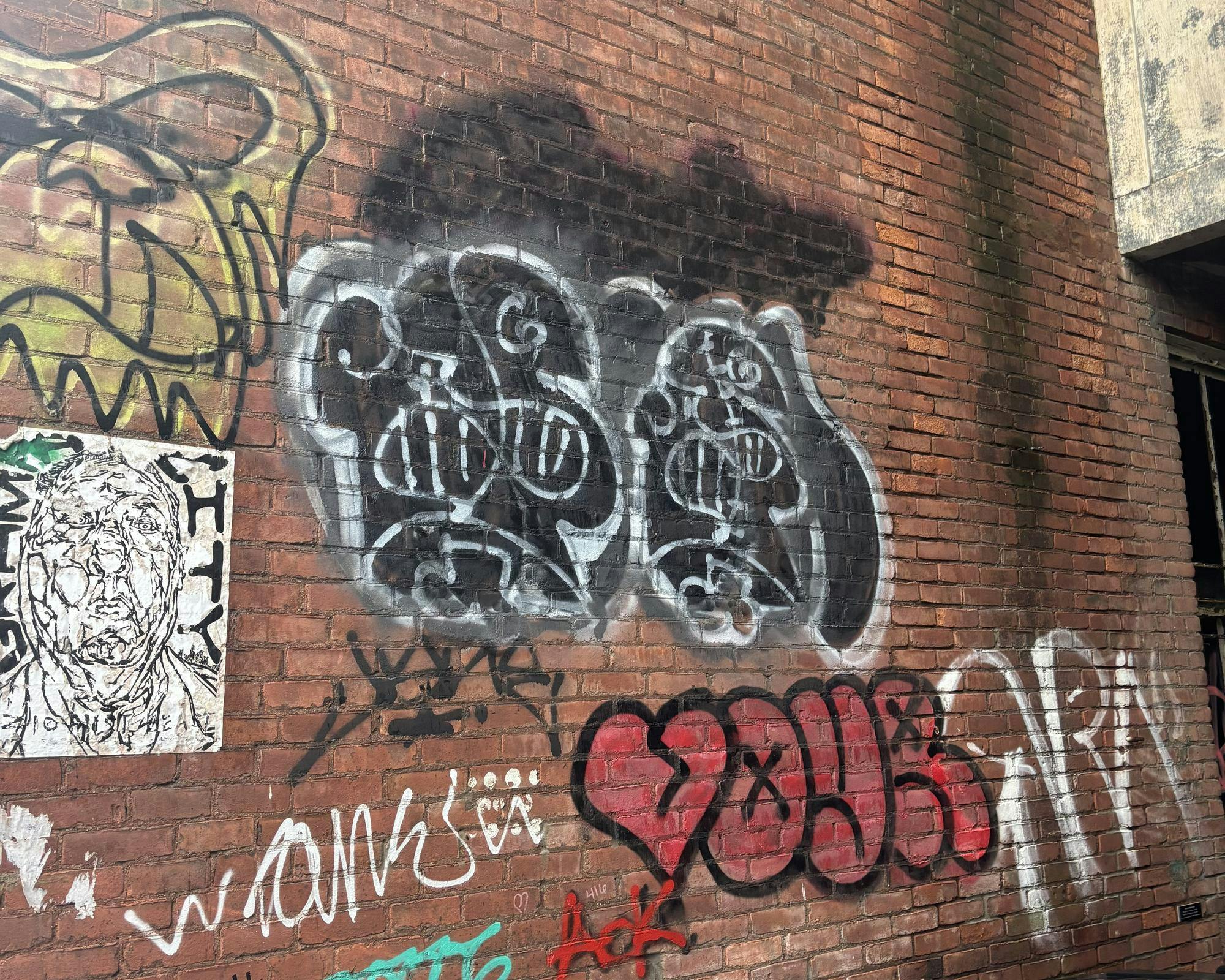
We’ve all done it, or at least thought about doing it: tagging. It can take any number of forms, from bubble letters on the sides of buildings to symbols of protest on statues to doodling on your desk in the Olin Library stacks. Tagging is the most localized, accessible form of public expression, even if the tag in question means nothing in particular. The very act of tagging, classified as “making graffiti” by New York State law, can land you jail time and a fine; just in tagging anything at all, you’re making a statement against order. If you want to take a Marxist lens to it, you could be making a statement against the inviolability of private property. No matter the approach, the common thread between any tag is its disregard for the order of a space in which one found it. It’s a uniquely human thing to want to leave a mark on any space in which you enter, and tagging is the epitome of that.
I grew up on the Lower East Side in Manhattan, and Delancey Street alone is littered with tags of all shapes, sizes, colors and styles. My apartment overlooked the Manhattan side of the Williamsburg Bridge, and from my bed you could crawl out the window onto a landing attached to the building’s fire escape. The brick wall opposite my window became my sister’s, my friends’ and my canvas for making our own tags. It began my junior year of high school, when my closest friends and I each played around with a can of spray paint against the exposed brick; the proximity of the experimental tags to one another reflected our tight-knit group. A little while later, my sister and her friends started tagging the wall as well, and for us the wall came to mirror the centrality of our house to our respective social lives. For me, tagging has very much said something about the space being tagged as much as, if not more than, it has said something about the taggers themselves.
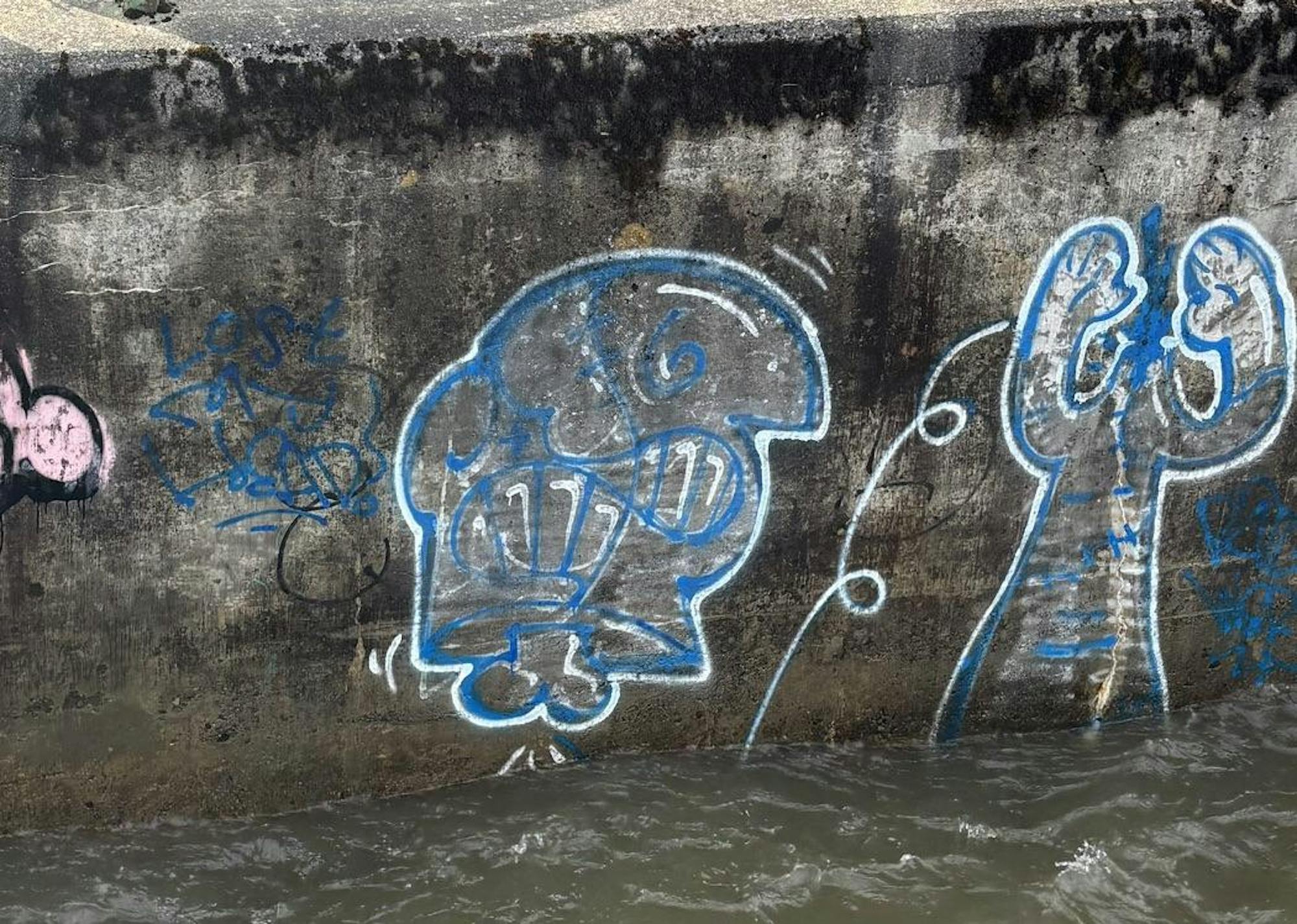
This idea has come to the fore for me again recently. On an aimless walk around Ithaca a couple months ago, I stumbled across a tag on the cement wall guiding Cascadilla Creek by Lake Ave., a little ways behind West Campus, that I couldn’t help but be entranced by. What grabbed my eye was its exquisite detail; I struggled to retrace in my mind the process through which the tagger made their mark. Its abstractness grabbed me as well. It’s shaped somewhat like a human’s head, but bares its teeth almost ferociously; its eye carries the weight of vision, despite it being only a quick spiral; what looks like a stitch runs waveringly through its smile and ties the head together with finesse. It has such incredible character, yet it has no identity.
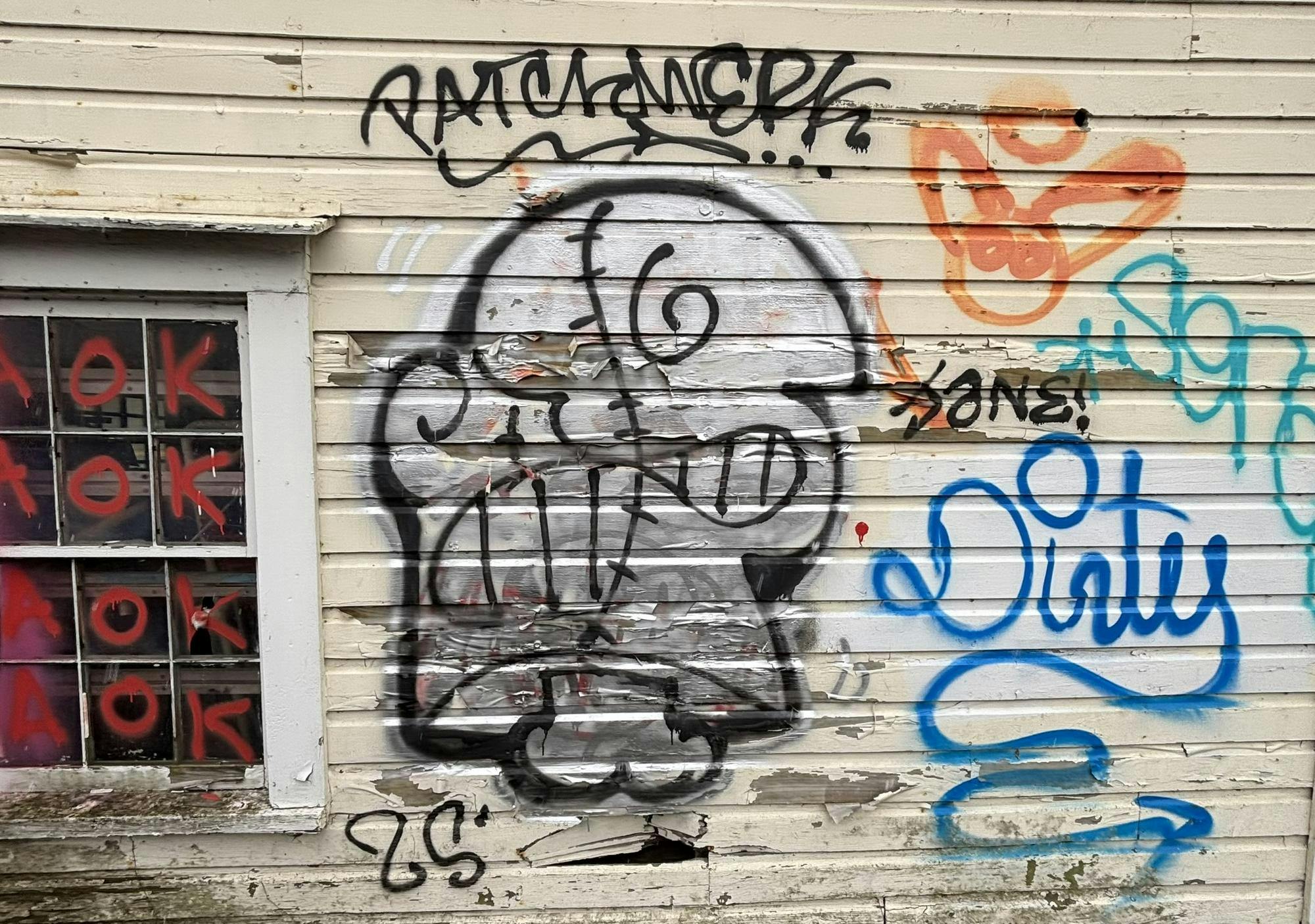
Over the following weeks, it started popping up everywhere I walked across Ithaca. Down by The Sun’s office on W State St., an even larger iteration of it blankets a neighboring building’s outer wall. There are dozens of them in the downtown area across just as many blocks.
Walking your way back up toward campus, the tag follows you into Collegetown as well. Look a little closer at the exposed brick or wood on any given block off-campus, and you’re sure to see this little guy peeking back at you. You needn’t stray far, either; here he is (twice!) on the same block as Jason’s Froyo, just around the corner from GreenStar.
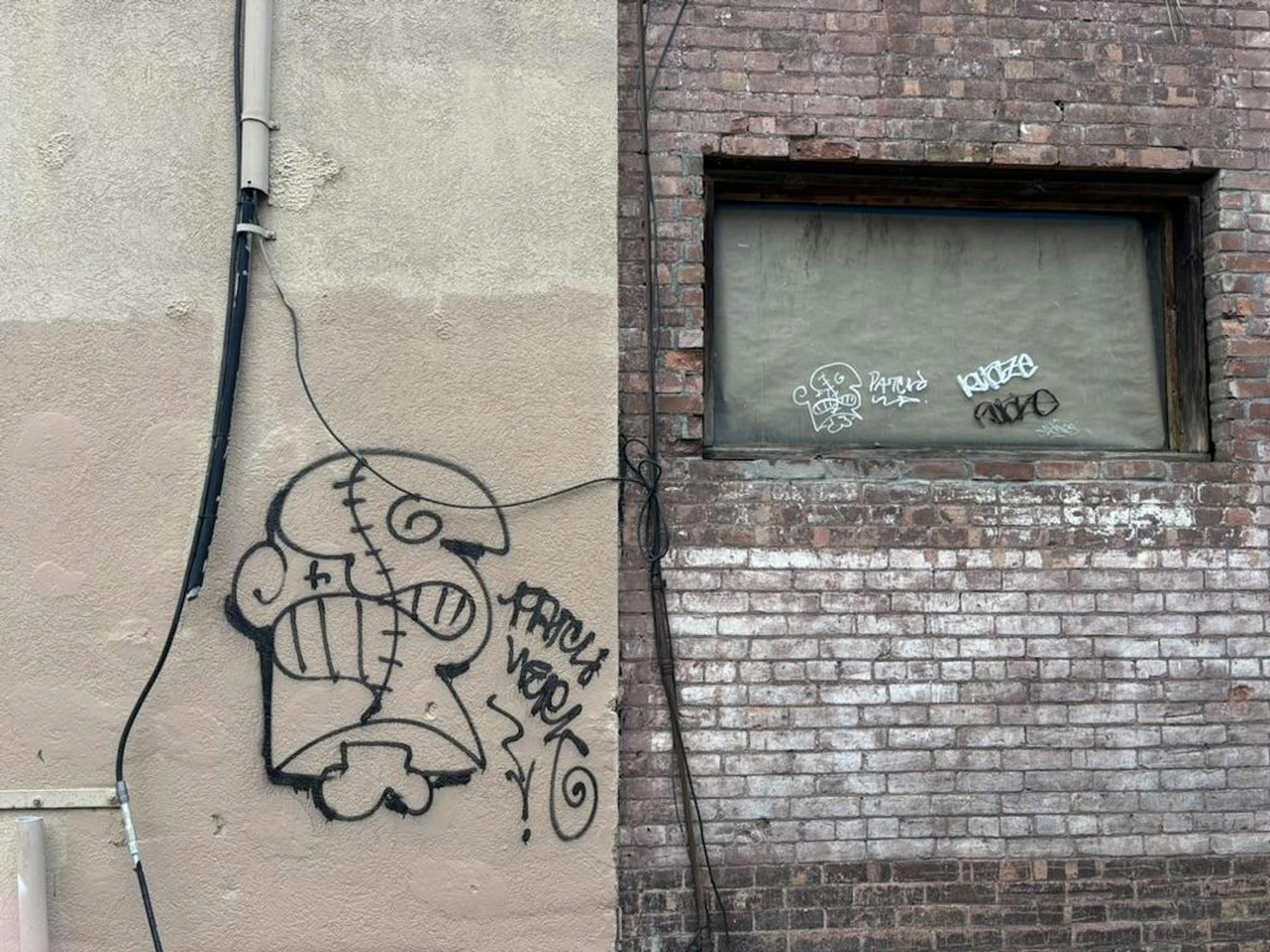
What’s drawn my attention to it just as much as its character, however, is the pointedness of where he’s tagged: off-campus. On a tag-searching bender one afternoon, I searched high and low across campus for it, and found exactly one — on a dumpster behind Cascadilla Hall. Even that spot is only on the cusp of ‘on-campus.’
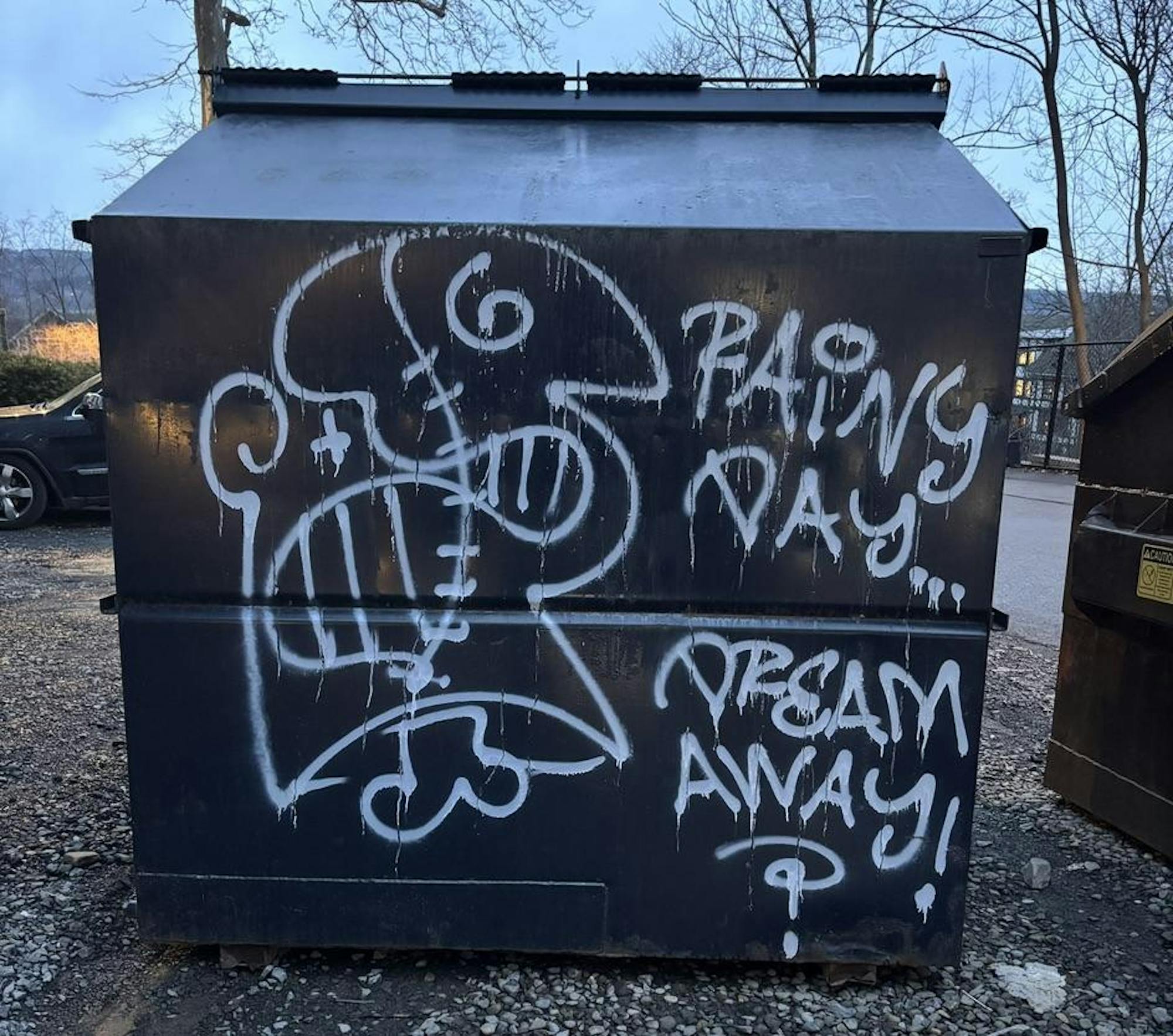
Which brings me back to my original point — a tag says something about the space being tagged as much as it says something about the tagger themself. What does it say that this character is seen all across the rest of Ithaca, but not on Cornell’s campus? Beyond the creative consistency of the unidentified artist, the tag communicates the existence of a metaphysical barrier between Cornell and Ithaca itself.
The tag’s prominence off-campus reflects a previously-explored peripheralization of the broader Ithaca community from Cornell. This periphery is most visible in conflicts between the University and the city itself, like in the fight over voluntary contributions to the Ithaca City School District, but also in the way that Cornell mandates two-year on-campus housing and meal plans, which zap any need for students to leave campus and explore Ithaca at all. The University’s negotiations with the city over TCAT funding last semester further illustrates this tension; even more, Cornell only provides free bus passes for first-year students, making TCAT transportation, thus travel off-campus, cumbersome and inconvenient for returning students. To cap it off, Cornell has its own zip code separate from Ithaca’s.
Given all of this, why go through the work of tracking these tags to make an already-well documented argument? Studying tags takes this idea out of the political context, independent of specific people or data points or Cornell itself, and refines it in the abstract. Street art and tagging can reflect social dynamics in a space at the same time as they can reflect the taggers’ relationship to it. As the number of these tags surrounding Cornell’s campus grows, maybe too will our reflections on our relationship to Ithaca.
Alexander Walters is a member of the Class of 2028 in the College of Arts and Sciences. He is a contributor for the Arts & Culture department and can be reached at apw65@cornell.edu.