There are two types of mornings: the ones where your curls fall perfectly into place, and the ones where you stare into the mirror wondering if a braid is less of a stylistic choice and more of a survival tactic. For students with curly hair, the question isn’t just, “What outfit am I wearing today?” It’s: “What hair accessory is going to save me?”
On a college campus where walking from North Campus to Collegetown can feel like battling Ithaca’s personal wind tunnel, hair accessories have quietly become both functional tools and status symbols. Nowhere is that more obvious than in the rise of the Emi Jay claw clip.
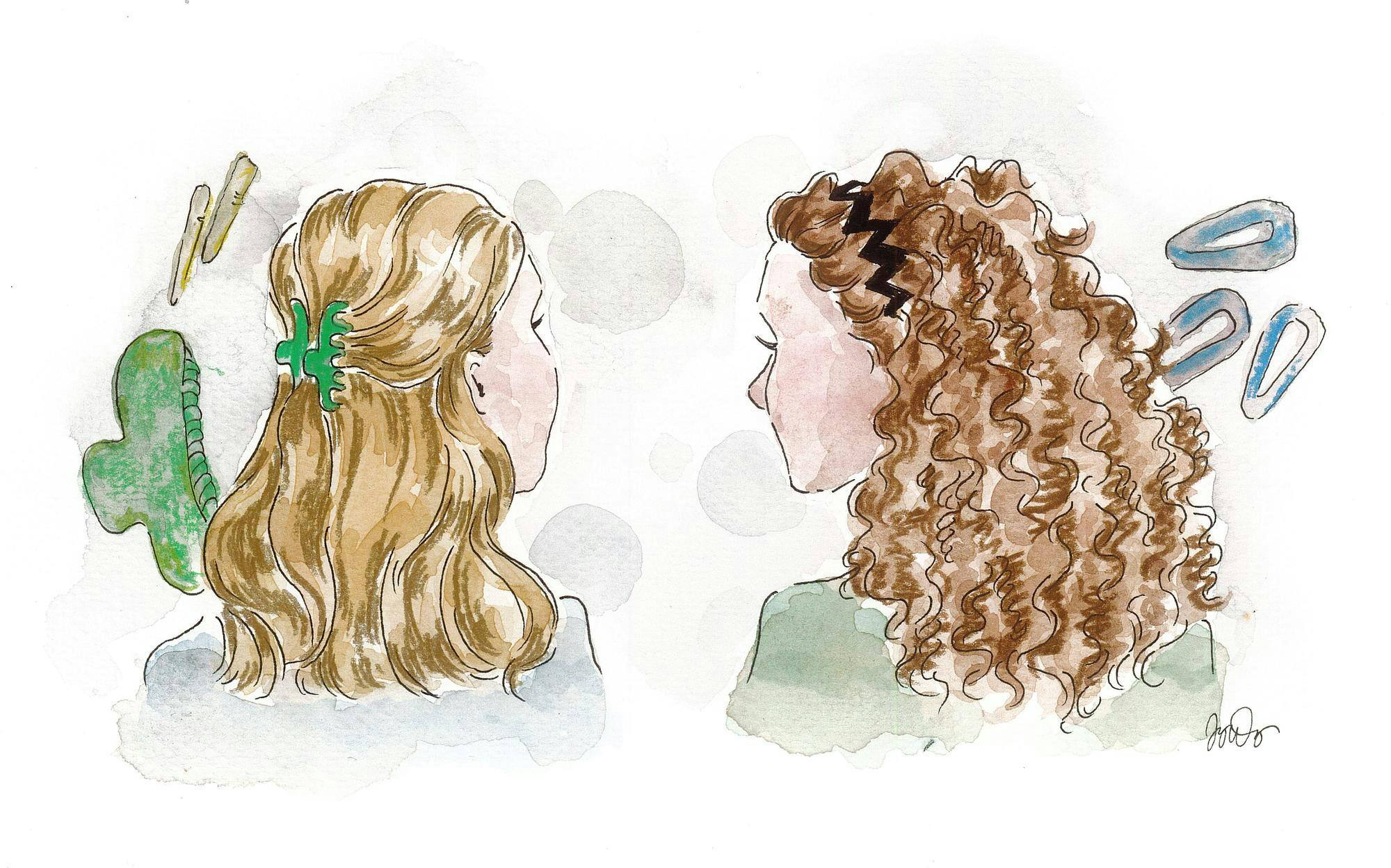
Emi Jay’s “Big Effing Clip”— yes, that’s the actual name — retails for about $36 to $38. And yet, it has achieved near-mythical status among Gen Z. The brand itself has become so recognizable that some students refer to all claw clips as “Emi Jays,” a testament to its cultural dominance.
Why?
Part of the appeal comes down to design. These clips feature playful, eye-catching styles, from floral shapes to butterfly-inspired details. A regular clip might be dismissed as boring and ‘not cute,’ and that perception turns students away from purchasing more affordable claw clips. Additionally, Emi Jay reports that their clips are “made entirely by hand, [with] each clip designed to guarantee reliable form, function, and comfort for all hair types,” but is this a premise solely based on trends? Or is it really a hair clip that is as life-changing as people claim?
A standard claw clip — typically under $10 — does the basics: clamps, holds and hopes for the best. It’s functional, but often flimsy.
An Emi Jay clip, on the other hand, markets itself as a “must-have accessory,” quoted from Glamour Magazine and highlighted on the Emi Jay website: “The claw clip remains one of this year’s must-have accessories.” Vogue’s take on the Emi Jay clips is also quoted on the website, stating, “Not to be dramatic, but Emi Jay’s big effing clip is the best thing that’s ever happened to me.”
Not to be dramatic, but these statements from Emi Jay, Vogue and Glamour Magazine sound extremely promising. The section for each of Emi Jay’s products has a sentence advertising why their clip stands out from the rest. On the claw clip subpage, Emi Jay writes that these clips are “made entirely by hand, designed to guarantee reliable form, function and comfort for all hair types.”
In theory, you’re paying for durability and design. In practice, you’re also paying for the feeling of owning something elevated, and students know it.
Owning an Emi Jay clip signals a certain aesthetic: put-together without trying too hard, casual but curated. It’s a small luxury that feels intentional, even on the most chaotic mornings.
If the claw clip is about containment, the zig-zag headband offers a different approach. Instead of pulling hair up and away, it pushes it back — allowing curls to exist while still creating structure.
Once a staple of the early 2000s style, the zig-zag headband has quietly made its return on campus, but its appeal today feels more practical than nostalgic. For curly hair, it solves a different problem: keeping hair out of your face without flattening it or forcing it into a bun.
Where claw clips can sometimes compress curls or create tension, the zig-zag headband works with the hair’s natural volume. It embraces the chaos rather than trying to tame it completely. On days when your hair refuses to be controlled, it offers a middle ground: intentional, but not restrictive. What makes these two accessories interesting isn’t just their popularity, but the very different ways they solve the same problem.
The claw clip — especially higher-end versions like those from Emi Jay — prioritizes hold and containment. It’s about gathering everything together, creating a clean silhouette and moving on with your day. The zig-zag headband, on the other hand, is about framing rather than fixing. It doesn’t hide volume or texture; it highlights it, while still offering some control. Both serve practical purposes. Both save time, but they also reflect different attitudes toward hair itself: one leans toward managing unpredictability and the other toward accepting it.
It might seem trivial to spend time thinking about hair clips and headbands in the middle of a demanding academic environment. However, these small choices reflect something larger. At a university like Cornell where students are constantly balancing pressure, appearance and identity, even the smallest routines can take on meaning. Hair, especially for those with curls, is rarely neutral. I can speak on this, as I feel that when my curls are not necessarily behaving, I just throw on my zig-zag headband and call it a day. My hair, along with many others, is unpredictable, visible and often tied to how we feel presenting ourselves in public spaces.
Accessories become tools not just for styling, but for navigating that uncertainty. Whether it’s investing in a $38 claw clip that promises to hold everything together or reaching for a zig-zag headband that lets your hair do its own thing, the goal is the same: to walk out the door feeling prepared.
Because at the end of the day, the real question isn’t whether claw clips or headbands are better. It’s how we deal with the unpredictability that comes with being human — starting, for many of us, with our hair. And tomorrow morning, the question will still be there: What’s my hair going to do today?

Maya Rothbard is a sophomore in the College of Arts and Sciences. She is a staff writer for the Lifestyle department and can be reached at mrothbard@cornellsun.com.