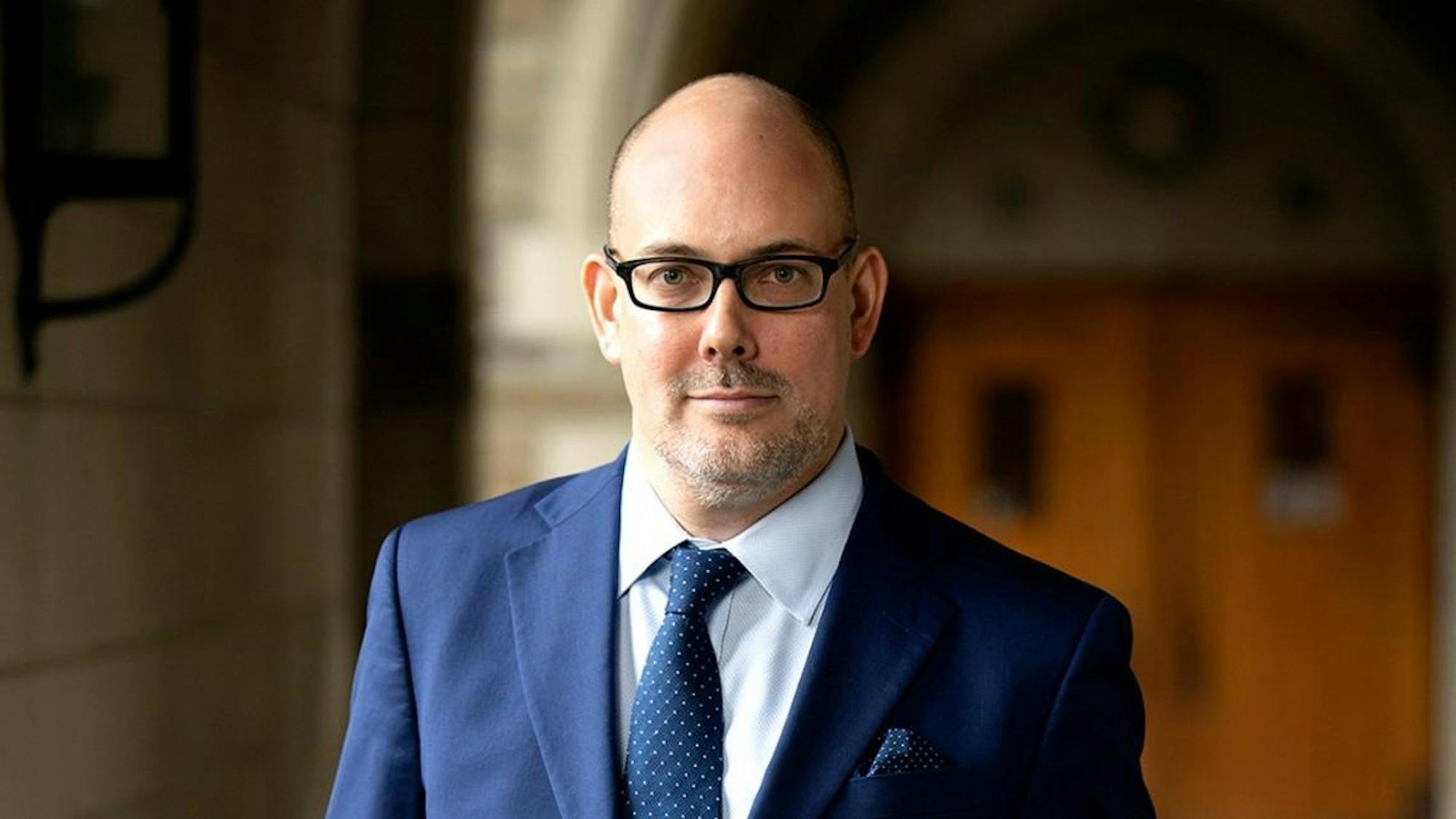
In response to student backlash after the Cornell Law Federalist Society hosted controversial speakers Amy Wax and John Eastman, Dean Jens Ohlin wrote to the student body that the law school does not screen speakers for their political beliefs in a Tuesday night email.
The Cornell Federalist Society is a chapter of the national Federalist Society, a legal group focused on promoting conservative and libertarian theories.
Wax, a law professor at the University of Pennsylvania who is currently suspended for making “racist, sexist” remarks, lectured students on March 25.
Eastman, who spoke on April 16, was disbarred on April 15 for his role in attempting to overturn the 2020 election.
“Requests to host outside speakers, whether from students or faculty, are not approved or denied based on the viewpoints of those speakers,” Ohlin, the Allan R. Tessler Dean and professor, law, wrote. “To suggest that past events were scrutinized or treated differently from other events at the law school, including ones this semester, based on viewpoint content, is false.”
Ohlin also addressed questions about “why police show up to some events and not others.”
Two officers were present at Wax’s speech, but none were present at federal Judge Michelle Childs’s March 19 event hosted by the law school.
Childs serves on the United States Court of Appeals for the District of Columbia Circuit and has faced death threats, partly for her role in the appeals panel that rejected President Trump’s claim that he should be immune from criminal prosecution.
“Her whole talk was about how she has been facing death threats from people, and there was no security at the event,” Ian Hayes J.D. ’26 told The Sun in an April 6 interview.
CUPD reviews all room reservation requests, Ohlin wrote, and then determines independently whether an event needs law enforcement presence “to ensure that it runs safely and is not disrupted in a way that would interfere with the speaker’s freedom of speech or the audience’s right to consume that speech.”
“If a judge is not escorted by CUPD, it is because the judge declined that service,” Ohlin wrote in the email.
Ohlin wrote that "institutional restraint” should not be interpreted as a “lack [of] commitment to fighting discrimination or hatred.”
“Discrimination and hatred are flatly inconsistent with the ‘any person, any study’ founding ethos of this university and this law school,” Ohlin said. “And let me be clear: I personally and unequivocably [sic] reject hatred and discrimination in any form and against any group that might suffer mistreatment or loss of dignity.”
In the email, Ohlin also detailed the law school’s $175 million five-year fundraising goal, which he said the school would “blow past” before its July 1 end date. He wrote that the money has “radically” expanded the school’s loan-repayment program for public interest graduates making under $120,000, with partial coverage for those making under $150,000.
“We have so much to do, and the burden on your shoulders is heavy, but that’s why we became lawyers,” Ohlin closed. “Armed with the law, I’m confident that each of you will make a profound contribution to the rule of law, our democratic system, and the greatest good.”

Atticus Johnson is a member of the Class of 2028 in the College of Arts and Sciences. He is the off-campus news editor for the 144th board.