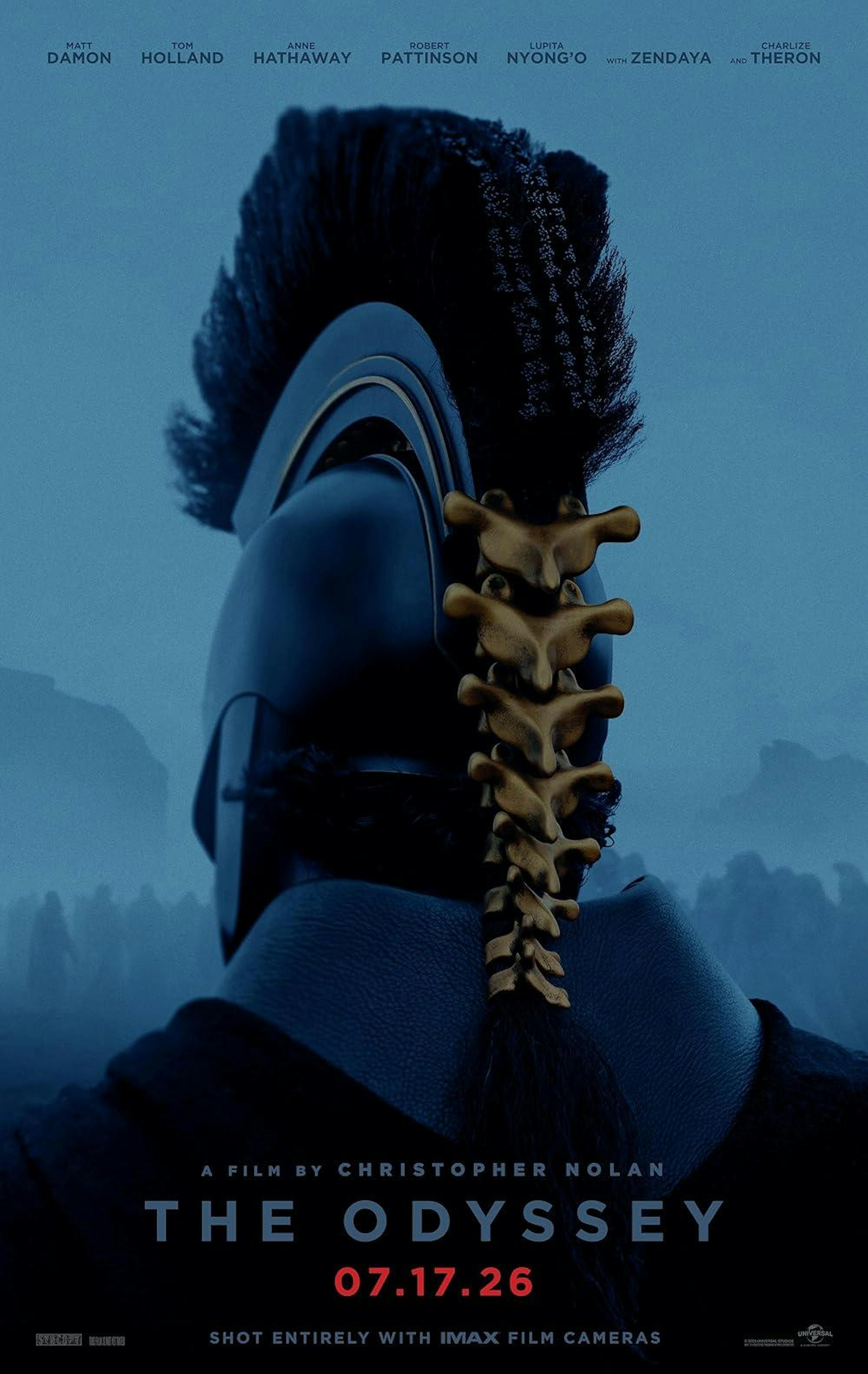
In case you haven't heard, The Odyssey is getting the Christopher Nolan treatment. With a cast including Matt Damon, Anne Hathaway, Zendaya and more, the film certainly promises greatness. Set to release on July 17, The Odyssey will follow Odysseus as he journeys back to Ithaca after the Trojan War. Anachronistic costuming aside, this article will focus on the story of The Odyssey itself.
Already, I am concerned with supposed clips involving the Trojan Horse. The Trojan Horse does not actually appear in Homer’s The Odyssey; it is used during the war. The famous scene is part of another poem called the Little Iliad. The Trojan Horse is referenced once in The Odyssey, but is not central and thus should not appear in the movie. Let's dive into what is actually in the epic.
At its heart, The Odyssey is a nostos — a homecoming. For Odysseus, this takes 20 years. Crucially, the narrative is non-linear, with much of it told by Odysseus in flashbacks. Homer likely did this to establish a clear divine protagonist, Athena, and an antagonist, Poseidon. Athena is initially upset with Odysseus after the war in Troy because Ajax assaulted Cassandra upon her shrine. Therefore, the epic begins when she is no longer angered and flashbacks show what happened before. There has yet to be a faithful adaptation that retains Homer's non-linear narrative, and I think Nolan is well-suited to the challenge, especially with his previous time-twisting works like Interstellar and Memento.
For those who have not read The Odyssey — beware, spoilers ahead! Although it has been out for thousands of years, so you've had time.
The Odyssey is an epic poem split into 24 books. The opening books are set in Ithaca, Greece and show Odysseus’ wife Penelope and his son Telemachus awaiting his return. The narrative then switches to Odysseus after seven years trapped on Calypso’s island. She eventually lets him go, but his journey remains tumultuous. Poseidon causes a shipwreck that leaves him on the island of the Phaeacians. It is here that the narrative switches to first person flashbacks from Odysseus’ perspective. Seeing how Nolan frames Odysseus’ character in these potentially unreliable flashbacks will be interesting to watch.
After the war, Odysseus and his crew travel to an island of Cyclopes, where Odysseus is taken captive by Polyphemus, a Cyclops son of Poseidon. Odysseus stabs Polyphemus in the eye, blinding him, to escape. However, as he sails away, Odysseus proudly yells his name so that Polyphemus will know who bested him. Polyphemus then prays to Poseidon for vengeance, which explains the origins of Poseidon's wrath. This moment could perhaps serve as a powerful opening to the movie to solidify Poseidon as the antagonist and introduce tension.
From there, Odysseus ends up on the island of the witch Circe who tells him to journey to the Underworld. At the veil to the Underworld, Odysseus speaks to a prophet, his mother Anticleia and Agamemnon among others. Agamemnon tells the story of his death, in which he was murdered by his wife Clytemnestra for his sacrifice of their daughter Iphigenia. This negative nostos shadows Odysseus’ own homecoming, specifically the initial tension with Penelope. Along with the non-linear narrative, this negative nostos should haunt the movie's narrative and play into subtle character acting.
Throughout the rest of his journey, Odysseus encounters a host of mythical monsters including sirens, the six-headed Scylla and the giant whirlpool, Charybdis. I will be interested to see how Nolan chooses to portray the sirens, especially because their origins are avian. The Greeks borrow the creatures from the Egyptian Ba, a human-bird psychopomp. Over many retellings, the siren has slowly morphed into a mermaid-like creature common in modern schemas. Choosing to show some bird features on the sirens would be the most faithful to the original text, which no adaptation has done yet.
After hearing his story, the Phaeacians help Odysseus return to Ithaca — but not as himself. Athena shrouds Odysseus in disguise so none can recognize him unless by a physical or mental token. His mother is the first to recognize him, albeit in the Underworld, and this reflects anagnorisis, a type of recognition essential to nostoi. Once in Ithaca, there are waves of anagnorises, starting with Odysseus’ dog, Argos, who tragically dies upon seeing his master. Telemachus is the next to recognize his father, then the nurse Eurycleia and a swineherd by the physical token of a scar on Odysseus’ leg. Anagnorises are essential in the poem and widely debated in academia, so not including them in the movie would be a betrayal to the text. I hope all anagnorises are included, even poor Argos.
The last anagnorisis is Penelope’s, which happens after Odysseus defeats the suitors who have been using his wealth and hoping to marry his wife. He ends up defeating them in a challenge, then slaughtering them and those who supported them. There is a cloud of moral miasma in this violent scene which brings Odysseus’ heroic virtue into question — something I hope Nolan retains to bring complexity to Odysseus’ character.
Penelope comes down after the fight and finds Odysseus absent a disguise, yet she does not believe it is him at first. She only recognizes Odysseus after he makes a comment about their bed only he could know. However, there is debate as to whether Penelope recognizes Odysseus earlier. I’m hopeful that the star-studded cast will be able to portray this ambiguity.
Overall, I am incredibly excited to watch this movie in July, and, yes, I will certainly be annoying about it — but now you can be too! If you have yet to read The Odyssey, I recommend Emily Wilson's 2017 translation.
Thank you to Professor Todd Clary, senior lecturer in Greek Mythology and Classics, for lending his expertise to the content and accuracy of this article.
Ayla Kruse Lawson is a member of the Class of 2027 in the College of Human Ecology. She is a staff writer for the Arts & Culture department and can be reached at akruselawson@cornellsun.com.