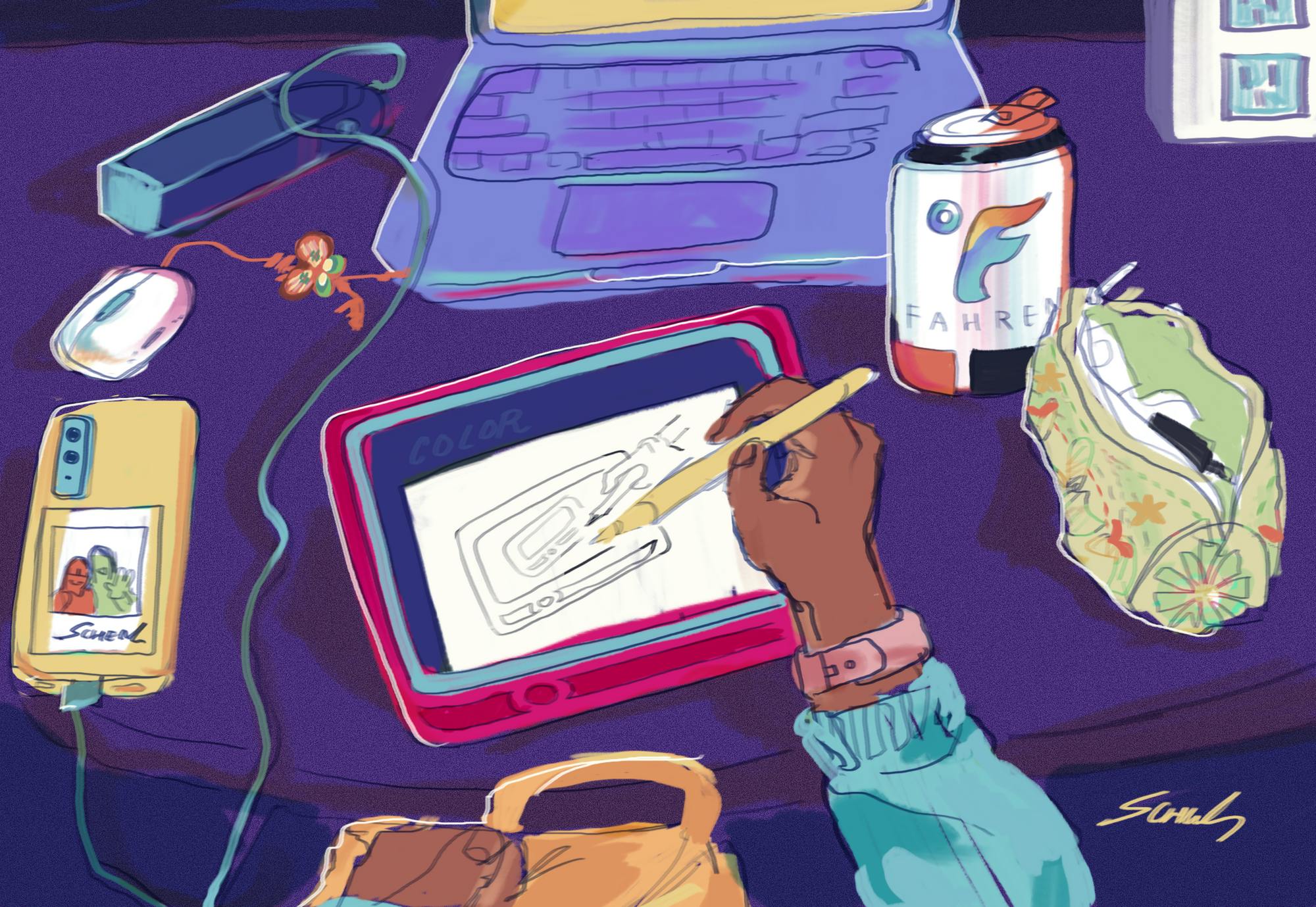
Has it ever felt like no matter how well you slept the night before, how much coffee you drink or how much water you consume throughout the day, your concentration still fades after just 20 minutes of work? You are not alone. In addition to sleep and hydration, where you choose to study really matters. By this, I do not mean that you should be in your room, a private library carrel or a cafe. Of course those places can help, but fulfilling those conditions does not guarantee sustained focus.
There is one more factor that is usually overlooked while studying for deep work: color. The colors surrounding us that we stare at for some 20 to 40 seconds during short breaks impacts studying. These short visual breaks can actually shape how effectively we return to our study space.
According to Nancy J. Stone’s research published in the Journal of Environmental Psychology, the color of your environment does not just affect how a room looks, it shapes how well your brain does its job. In her study, students who completed a reading comprehension task in a red-colored space scored lower than students in a white-colored space. This means that red is a stimulating color that competes for your attention. This also means that when the task you are doing already demands deep concentration — like reading a dense paper or working through a problem set — red divides your attention into two directions.
Blue, on the other hand, works in your favor during demanding cognitive tasks like studying for finals. This color is mostly associated with calmness and mental clarity. Stone’s study also found that students in blue spaces reported higher positive mood during open study settings. If you have any say over the color of your study space, whether that means your dorm room wall, a poster above your desk or even your laptop wallpaper, leaning toward cooler blues during finals is a good choice.
Green may be the most underappreciated color but the most available color in Ithaca. A study by Kate Lee and colleagues at the University of Melbourne found that students who spent just 40 seconds looking at a green roof during a break could concentrate better than students who looked at a bare concrete roof. The researchers backed their study with Attention Restoration Theory, which claims that natural environments allow the brain’s voluntary attention system to briefly recover. This could also mean a little plant on your desk or nature photo set wallpaper and screensaver which might help you a little through a long study session.
Yellow and orange also have a place in this picture, though they are better for creativity and energy than for the sustained and focused reading most of our finals demand. These two colors are probably better for your group study session than the wall behind your screen.
None of this means you need to repaint your apartment in Collegetown before your organic chemistry final. These takeaways can be implemented in moderate ways. When you take a study break, instead of scrolling through your Instagram feed, step outside or stand by a window and observe the green trees; we have a lot of them in Ithaca. Additionally, set your screensaver to something green or cool blue rather than a high-contrast image. If you are choosing between two library spots, pick the one near a window with natural light.
The research does carry an important point worth mentioning: Individual responses to different colors vary, and no single color is universally optimal for every person or every task. A color that helps you focus during reading may do nothing during math coursework and vice versa. The broader point is that the visual environment you work in is also an active participant in how well your brain functions.
The Cornell campus, fortunately, gives us a natural green color. The Arts Quad, the Slope and surrounding landscape are not just scenic. They are, in a measurable sense, good for your brain. When you are taking a break, let your eyes rest on something green before you go back to the page or screen.
So before you get your third coffee from Libe Cafe during finals, take a look around and embrace the natural environment.

Abdurrahman Ali is a member of the Class of 2027 in the College of Arts and Sciences. He is a contributor for the Arts & Culture department and can be reached at aa2478@cornell.edu.