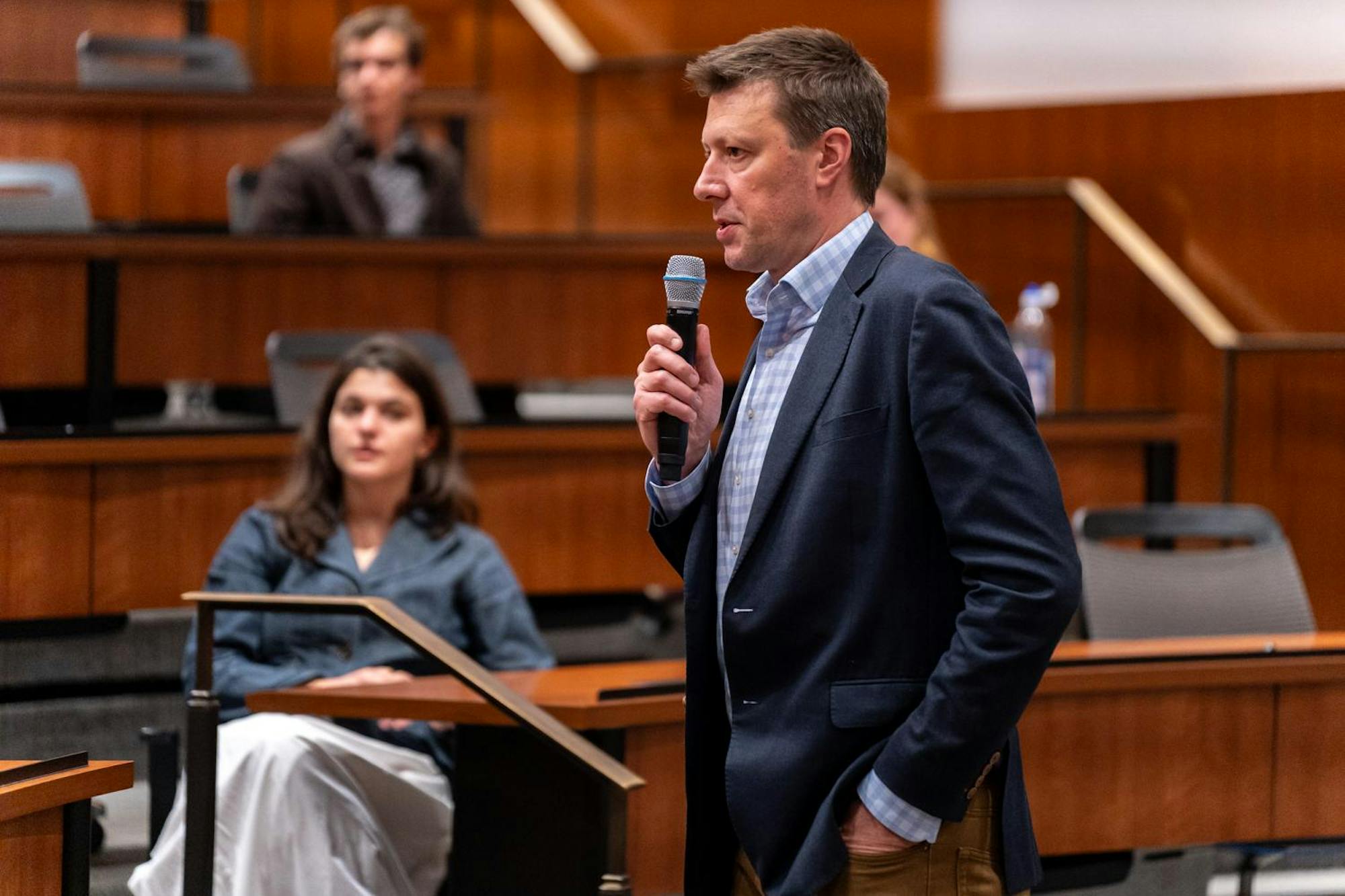
The American Constitution Society at Cornell Law School hosted Rep. Josh Riley (D-N.Y.) for a Q&A on Thursday evening at Myron Taylor Hall. The event, open to all members of the Cornell community, allowed students to speak directly with Riley ahead of his bid for re-election in New York’s 19th congressional district, which includes Tompkins County.
Thursday’s discussion centered around denouncing corporate political action committee funding, giving advice to law students in attendance and addressing rising utility prices in the 19th congressional district.
Federal aid for universities
Riley discussed a bill he voted for on Sept. 3 that would withhold federal aid for universities that engage in boycotts against Israel.
The Protect Economic and Academic Freedom Act, which passed the U.S. House, 237-169, with mostly Republican votes, would make universities who engage in “nonexpressive commercial boycotts” of countries designated as “major strategic partners” — Israel is the only state labelled as such — ineligible for student aid funding.
As of July, Riley has received $244,570 of funding from individuals associated with the American Israel Public Affairs Committee, according to OpenSecrets, using data from the Federal Election Commission.
One student questioned why Riley criticised President Donald Trump for cutting funds to universities to research and science, but finds threatening federal funding acceptable in this case.
“There’s a narrative, I think, out there that [the bill] dealt with First Amendment activities and First Amendment expressive activities — it didn’t,” Riley said. “Peaceful protest is a cornerstone of our democracy for generations. … What that bill was, actually, was an anti-discrimination bill.”
He expanded on his answer, noting that he imagined how the bill would affect his district before he made his vote.
“At Cornell, for example, there are some really great exchange programs that are strengthening communities around the world, whether it’s Palestinian faculty coming here to teach [or] whether it’s students from Upstate New York having a chance to go to Tel Aviv,” Riley said. “I think I want to protect those from discrimination.”
Riley explained that the bill was intended to prevent universities from “quietly stop[ping] exchange programs with any of our allies.”
Immigration and the “American Dream”
Throughout the Q&A, Riley discussed immigration and specific instances of immigration affecting his constituents.
On immigration, Riley said that the U.S. immigration system “needs to be fixed,” stating that most people want a system that follows “common sense.”
“If you're here and you’re working hard and you’re paying your taxes and you’re following the rules, then you should have an opportunity to pursue the American Dream,” Riley explained as a “common sense” solution, before adding a criticism. “At the same time, it's not fair to anybody, especially a lot of immigrants, to have people [here] who have committed violent crimes and … who are harming the community.”
As a representative of over 4,500 farms, Riley said that the “number one thing that keeps [dairy farmers] up at night” is their fear that “ICE is going to show up and raid the farm and take away workers who have been with them for generations — who are driving our economy.”
Riley said that undocumented farmworkers are not at fault. Rather, he said it is “the [fault of] politicians in Washington who have been screwing around on this issue for decades instead of actually solving the problem.”
Riley introduced the Securing Agriculture’s Workforce Act to Congress in July to reform the H-2A visa program to better serve the dairy farmers and apple growers in the Upstate New York region.
“Sweeping fundamental reform”
When asked about the value of bipartisanship, Riley pointed to the 172 towns across 11 counties his district encompasses, making it the 16th most rural congressional district in the nation, according to Riley.
Riley explained his district’s constituency reinforced the bipartisan values he adopted in Endicott, New York, the factory town he grew up in.
“[In Endicott,] people were less concerned with their political party labels and more concerned with whether you are willing to roll up your sleeves and fix problems,” Riley said.
The moderator asked Riley, “How do you think that we can begin to restore trust in the government?”
Solving challenges requires compromise down the aisle, Riley answered, particularly in the 19th congressional district, he added, which consists of a roughly equal split between Democrats, Republicans and Independents, according to Cook Political Report.
Riley referenced his failed Drain the Swamp Act, which he said would “ban corporate PACs, overturn Citizens United, impose term limits, get rid of the partisan gerrymandering and stock trading by politicians.”
Though he said the bill was controversial, Riley insisted that this kind of “sweeping fundamental reform” was necessary. Riley co-introduced the bill alongside Rep. Greg Landsman (D-Ohio). The bill would prevent members of Congress from owning or trading individual stocks, establish 18-year term limits for members of Congress and the Supreme Court and overturn Citizens United.
Riley emphasized that the bill was meant to support working-class Americans like his constituents in Endicott.
“I didn’t go into politics to be a celebrity,” he explained. “I love this community with all my heart, and I want to make it better.”
Riley also pointed to “rampant corruption in the government” and an economy “rigged against the working class” as inspirations for starting his political career.
Riley sponsored several bills aimed at improving affordability, including the Weatherization Enhancement and Readiness Act in February 2025 for energy efficiency in low-income households, the Keep the Lights Local Act in September 2025 to ban foreign ownership of utilities and the No Bonuses For Utility Executives Act in December 2025 to prevent utility companies from using increased rates to pay bonuses to their CEOs.
The Q&A closed with Riley emphasizing his constituents' frustration with the current political system, particularly with increased polarization.
“There is a real, deep-seated and justified sense of frustration that our political system is corrupt and it is not working for the people,” Riley said. “The underlying current is that … the system right now is corrupt and the economy is rigged. We need to be bold about changing it.”
Francesca Wesley is a member of the Class of 2029 in the College of Arts and Sciences. She is a contributor for the news department and can be reached at fjw48@cornell.edu.
Maya Johansen is a member of the Class of 2029 in the College of Arts and Sciences. She is a contributor for the news department and can be reached at mhj49@cornell.edu.