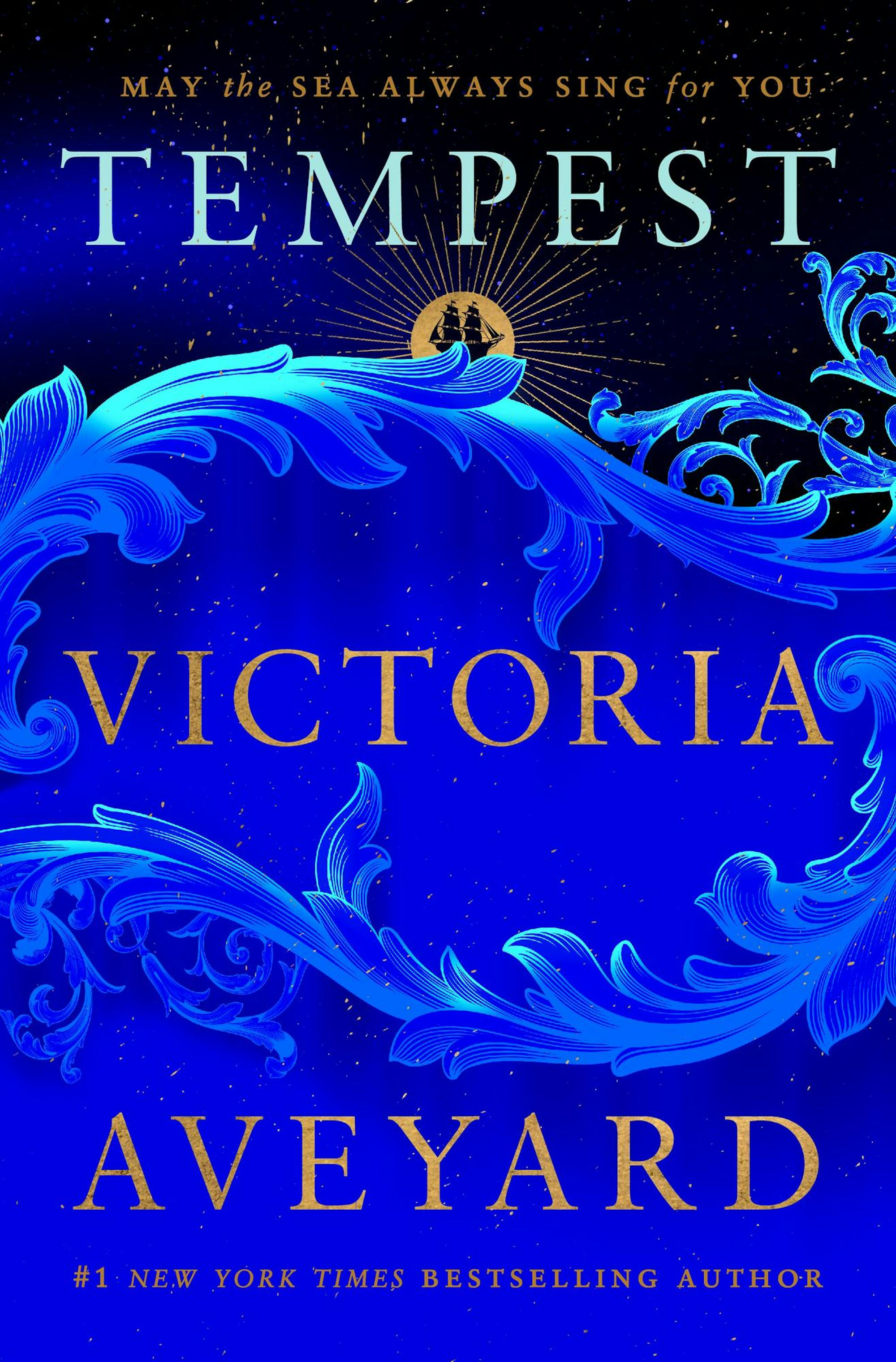
There is something brewing on the horizon, something taking shape in the wind. Waves lap lazily against salt-sprayed wood, rocking a heavy ship on its keel. The rigging strains, the wood groans and the sails snap against the wind's playing fingers. And if you listen closely, there is something on that wind — the unsettling moan of a hollow wooden flute and a raspy whisper of a forbidden song. The song of the sea, a pirate's song.
I am unsure which seawitch Victoria Aveyard bartered with to get a bottle of this feeling, but whatever the means, the results are certainly magic. The pages of Tempest are cloaked in the fog of this unstoppered bottle and effuse the smell of salt, sweat and sea storm. It is a delight to read and to watch the world of the Lyrian Sea spring to life like pieces of a pop-up book.
Following Lady Catrine Rose, aka the Widow Rose, the novel dances between her many lives, her many struggles and her ever-changing loyalties. But there is one part of her that will never change — Cat is always looking out for her survival. “My head or theirs” is the mantra beating alongside Cat Rose's heart, and despite the many flawed choices that mantra enables, the reader is right there smiling alongside her. Victoria Aveyard supports women's rights in Tempest, but she also supports women's wrongs. From the Meridian Empire to the islands of the Lyrian Sea pockmarked with flags of distant nations and no flag at all, Tempest is an adventure of political turmoil and survival, but also a quest to live and to live voraciously. It was a world that truly felt alive and painfully real.
One of my favorite parts about Tempest was the imagery. I don't just mean Aveyard's descriptive, vivid language; I mean the images she chooses to paint and where she places them in the narrative. A swaying wooden sign with a faded rose, a chip in the wood behind a captain's desk, the frayed end of a rope hanging from an arch, an ornate pistol swinging from the hips of two different men across time. All are images haunting in their brevity and swollen with implications of the past. I was enraptured by this imagery, both its nostalgia and its warning. Aveyard herself said she was inspired by the Pirates of the Caribbean series, which utilizes similar imagery like teacups filling with rain, a haunting sea shanty and an umbrella on the open sea.
It is clear Aveyard knows the power of nostalgia, and the pain memories can rend on the mind. With past and future plot lines, she often has Cat return to places from the past and show the ways her past still speaks to her. Further, titling chapters as “Before” and “After” sets an expectation that there is some dividing event between the two. This builds tension from the very beginning and keeps stakes mounting as the narrative inches closer to its acme.
Dual timelines also have the potential to commune with each other and for the past to prey upon the future or vice versa. And Aveyard certainly uses this potential in Tempest, especially in regard to Cat. As I read, I could not help but feel as if the old Cat and the new Cat hid between the lines, the ghosts of herself haunting the narrative. As a Lady of Meridian society, Cat knew a suffocating life of cloying formalities and restraint. The Lyrian Sea is a world unto itself; it is a world for anyone's taking, not just a world built to be won by the men of society. I am reminded of a quote by Ava Reid in her book A Study in Drowning: “When men fall into the sea, they drown. When women meet the water, they transform.” When Cat meets the Lyrian Sea, she too transforms. And the men that hold her back? They drown.
My only critiques of the novel center around plot. Even after finishing the book, I still could not really say what the plot was. I am usually completely down for a book with a loose plot — one of my favorite books of all time is The Night Circus — but here it felt lacking. The tempest readers are promised lurks, but never lands. It could have been the rapid switches between past and present that left me unable to ground myself in either time. I felt more grounded halfway through, but as a reader I would have rather expended mental effort on studying characters and feeling the weight of what was happening in the chapter rather than trying to remember what was going on. Additionally, I thought there could have been more depth in the side characters. I think the character building for Cat was incredibly well done, from her arc to her quirk of occasionally saying her thoughts out loud. But I did not feel I understood any other characters nearly as well. I was also hoping for some more supernatural elements, especially given the Pirates of the Caribbean inspiration, but that's just a personal preference.
All that aside, the world Victoria Aveyard has built with Tempest is exquisite. Reading the novel, her background in screenwriting is starkly apparent because, unlike almost any book you could take off the shelf, you can truly see everything that is happening. You can see the pirate captain walking towards you and know his tells; you can know the sea spray on your face, the heat beating down upon you and the sweat dripping down your chest as you climb to the legendary song towers of Crownless Arcayo. It is not just Cat Rose that goes on this adventure — it is you, dear reader. So for any reader who wishes to embark upon the Lyrian Sea: welcome, and “may the sea always sing for you.”
Thank you to Harper Voyager and Gollancz for an ARC of Tempest!
Ayla Kruse Lawson is a member of the Class of 2027 in the College of Human Ecology. She is a staff writer for the Arts & Culture department and can be reached at akruselawson@cornellsun.com.